Key Takeaways
- AI agents run on physical or cloud infrastructure like virtual private servers or GPUs, which provide computing power, memory, and database storage.
- Self-hosting appears inexpensive, but the true cost adds up to hundreds of dollars in lost engineering time for maintenance and troubleshooting.
- While self-hosting offers complete technical customization, managed AI agent hosting provides immediate deployment and automated security.
- The optimal choice is managed infrastructure to eliminate ops overhead while preserving full AI agent control.
AI agents aren’t just a fad. People are doing both mundane everyday tasks and super high-level scientific research with them. If you’ve already jumped in, you might have learned that setting up, subscribing to AI agent hosting, and deploying it is relatively easy; it’s keeping it functional that can be challenging.
To keep workflows smooth, people wonder whether to go for self-hosting on their own server or use a managed platform.
The best choice depends on the user’s technical skill, spending cap, security needs, and the number of agents needed. Right now, the agents market is well above $10 billion, growing exponentially, and being able to use agents is a major in-demand labor market skill.
- What is AI Agent Hosting?
- Self-Hosting AI Agents: What Does it Take?
- Managed AI Agent Hosting: What You Trade and What You Gain
- Managed vs Self-Hosted AI Hosting Comparison
- A Third Option: Managed Infrastructure, Full Agent Control
- How to Choose the Best AI Agent Platform for Your Situation
- Self-Hosted vs Managed AI Agent Hosting: Choose What Fits
- Frequently Asked Questions
What is AI Agent Hosting?
AI agents are software that independently complete tasks for you, using LLM models as the cognitive fuel. They call upon various ‘skills’ or ‘tools’ as necessary to achieve your goals. AI Agent hosting is the physical data center infrastructure where your agent’s computation and processing happen. You have options like managed cloud hosting, serverless GPUs, or virtual private servers, and more.
Don’t confuse this with agent-building platforms like n8n. These come in flavors like no-code visual builders, automation platforms, or code-first platforms. Such tools will help you define what your agents will do, and how.
The best AI agent platforms are OpenClaw and Hermes. Builders need processing power, RAM and working memory, database storage and security to use these agents, which AI agent hosting platforms provide.
Self-Hosting AI Agents: What Does it Take?

This path involves renting a server, usually a Virtual Private Server from a provider like DigitalOcean, and run everything yourself. The process goes like this:
1st stage: Launch your VPS server, install Docker, “pull” the agent’s framework (which means downloading the agent software to your server), configure environment variables, set up a database (Postgres and Redis), add an Nginx reverse proxy (an intermediary gateway between the user and the server), add SSL certificates, and connect your LLM to your tools via API or MCP.
2nd stage: Now you’ve got to make sure it works smoothly in the long-term. Self-hosting can spike your bill due to myriad reasons: the agent crashes, an unintended loop burns tokens uncapped, there’s no audit trail of agent actions, the agent loses memory, there are no staging copies to test changes, and manual security patching.
I’m not discouraging self-hosting AI agents. This route gives you total control over everything, and looks affordable in theory. A VPS might be as low as $6/mo. The true cost is not just the invoices, it’s your time: often estimated at $150–$250 a month in lost engineering hours just to keep a single agent running.
Managed AI Agent Hosting: What You Trade and What You Gain
Serverless AI agent hosting is a viable option for startups, for the dreamers who are building a MVP to pitch investors, and for small businesses looking for stability. Managed AI Agent hosting operationalizes servers, runs the containers, handles SSL, monitors uptime, does the drudgery of patches, and keeps your whole setup in a security lockdown.
All you have to do is sign up, hit ‘deploy’, and an agent is running in minutes.
The trade-off, with most managed AI agent hosting platforms, is control. Many managed agent hosts are flimsy wrappers around someone else’s stack. There’s usually environment lock-in to the extent that you can’t even export your setup.
The single-vendor fragility becomes conspicuous when their systems crash and you get poor support.
Don’t just ask “managed or not?”, ask “managed how?”
Managed vs Self-Hosted AI Hosting Comparison
| Dimension | Self-Hosted | Managed |
| Setup time | Hours to a weekend | Minutes |
| Visible cost | $6–$35/mo server | Flat monthly fee |
| True cost (with ops) | + $150–$250/mo in your time | Included |
| Security | Entirely your responsibility | Handled at the infra level |
| Scalability | Manual; you resize and tune | Spec upgrades on demand |
| Control / Customization | Total | Varies — often limited |
| Data residency | Full, if you configure it | Depends on the provider |
| Support | You, or community forums | Depends — best is real 24/7 |
| Portability | High (it’s your server) | Often low (lock-in risk) |
Objectively, I call it this way:
Self-hosting AI agents is the right choice when you have DevOps people and want minute control. This is likely most relevant to organizations that are complying with industry standards, and need custom networking. It’s also the play if you run a mass of agents at scale to make ongoing ops justifiable.
Managed AI agent hosting is better when you just want your agent to run flawlessly for months on end, without the need for regular human monitoring. This is the best route for freelance developers, smaller teams, and agencies.
You might wonder what the threshold is between these two options. I’d say up to a few dozen agents, managed AI agent hosting is the superior choice as it provides simplicity and optimizes costs. If you’re running a proper AI agent swarm, though, self-hosting takes the cost predictability trophy.
A business using a $29/month VPS needed four hours of troubleshooting, at $75/hour, so the outlay was really $329 that month. This is why you have to think in business terms about the best AI agent platform for your use cases.
A Third Option: Managed Infrastructure, Full Agent Control
The AI agent hosting landscape is not so cut and dry as just VPS you micromanage, or a locked-down wrapper you can’t control. Another popular service is managed infrastructure where you keep full control of the agent itself.
In this model, the host sets up and launches servers, takes care of isolated and hardened environments, SSL/TLS, container management, and version updates. Meanwhile, you retain full control over the agent’s skills, nodes, environment variables, and LLM connections.
You get to pick your region, upgrade specs, and watch usage in real-time, rather than trusting a black blox. It’s the best of both worlds: the control of self-hosting with the ops simplicity of managed AI agent hosting.
This path also opens up things the wrapper crowd can’t touch. Agencies and teams can run isolated multi-agent environments; one client’s agent can’t see another’s. Region and data residency become a setting instead of an enterprise-only privilege, which matters the moment an agent touches customer PII.
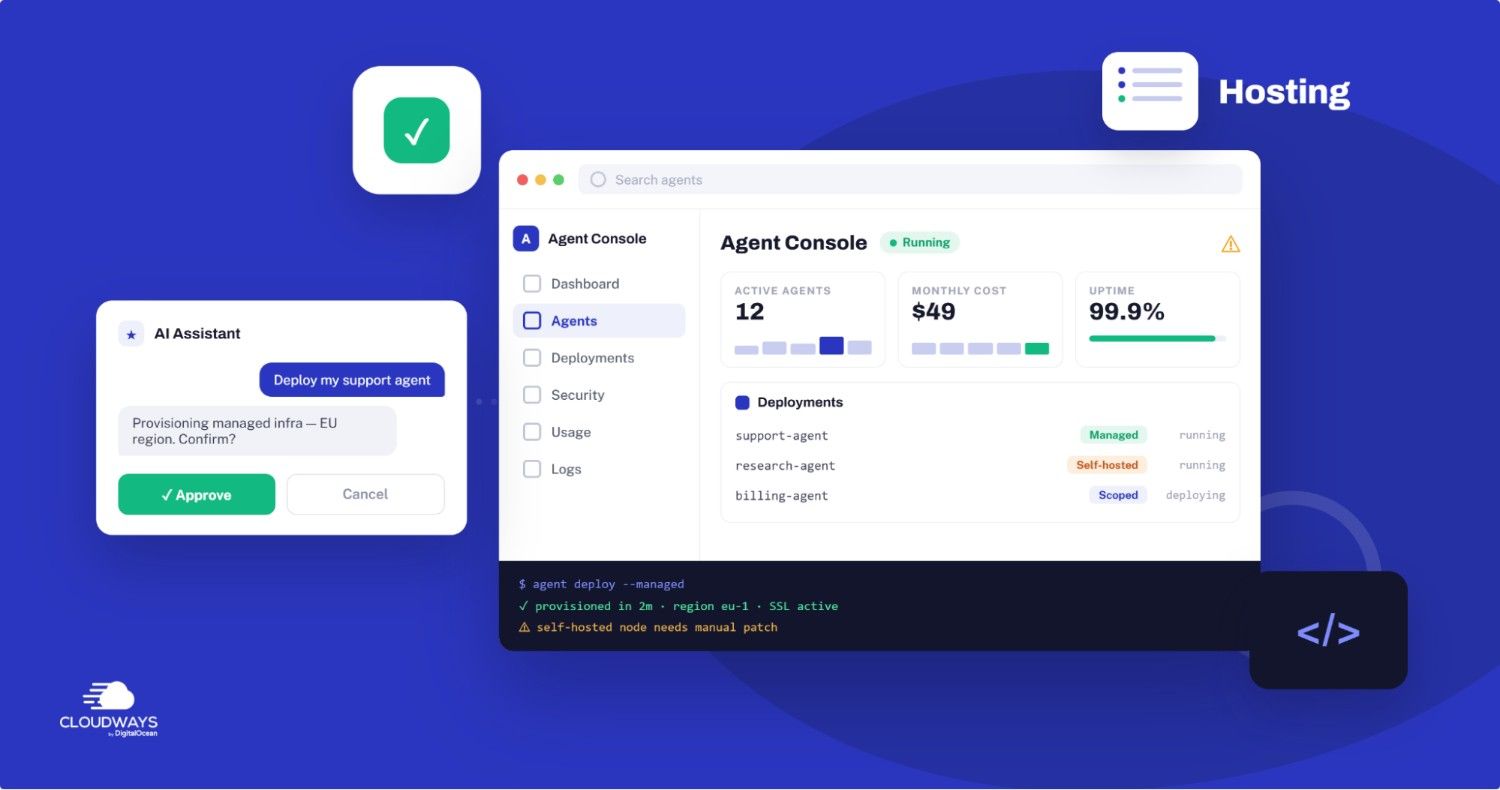
Cloudways Managed Agents Hosting delivers managed infrastructure that doesn’t hassle you, with an agent you still fully control. You can deploy your first agent in minutes, starting with OpenClaw.
How to Choose the Best AI Agent Platform for Your Situation
The best AI agent platform is the one that matches who you are. A few common profiles:
- The non-technical solopreneur who installed OpenClaw, hit a terminal error, and stalled; now needs one-click managed hosting, full stop.
- The developer or AI agency that wants to offer billable, recurring agent services without becoming an infrastructure company needs managed infra that still gives them full control of the agent.
- The RevOps / GTM engineer shipping internal automations needs reliability and time-to-ship without filing a ticket to IT.
- The SMB automating operations; usually best served through an agency that manages the agent for them.
- The regulated or data-sensitive buyer needs region-pinned, data-resident hosting, which often rules out opaque US-only clouds.
Run through a short checklist before you commit: How technical are you? How many agents will you run? How sensitive is the data? Do you want flat or usage-based pricing? What support do you actually need? And can you export and leave if you change your mind? Your answers point cleanly to one lane.
Self-Hosted vs Managed AI Agent Hosting: Choose What Fits
Self-host if you want ownership of the whole stack, and have the skills. Go work if you want to ship the agent and forget about the infrastructure. Just don’t take the usual trade-off as a given. Managed AI agent hosting should not mean losing control over your agent or being locked into someone else’s box.
Cloudways Managed Agents Hosting is designed for that middle ground: managed, secured infrastructure without Docker and without ops overhead, while you’re in full control of the agent. Start with OpenClaw today, and Hermes is up next.
Q. How much does AI agent hosting cost?
A. Self-hosting is about $6-$35/month for a server, plus 4-10 hours of setup and ongoing maintenance time, which normally costs $150-$250/month in real terms. Managed hosting is usually a flat monthly fee that covers the server, updates, monitoring and security.
Q. Can I host an AI agent for free?
A. You can run one on a free or trial VPS tier but you will pay in setup time, maintenance and LLM API usage. Free tiers almost never survive real traffic spikes.
Q. What’s the best way to host an OpenClaw agent?
A. If you are comfortable with Docker, SSL and Linux admin, then a VPS will work. If not (or if you want it to run reliably without manual supervision) then managed hosting that still lets you control the agent’s skills and configuration is the safer choice.
Q. Can I self-host an n8n AI agent?
A. Yes. n8n is popular to self-host, but like any agent it needs a persistent, always-on environment with proper backups and security, which is exactly the post-launch work managed hosting removes.
Q. Is managed AI agent hosting secure?
A. If the platform provides isolated, hardened environments, managed SSL/TLS and no shared-kernel exposure, it can be more secure than self-hosting. Different providers have different security capabilities, so check out how each one isolates agents before you give it your API keys or customer data.
Start Growing with Cloudways Today.
Our Clients Love us because we never compromise on these
Zain Imran
Zain is an electronics engineer and an MBA who loves to delve deep into technologies to communicate the value they create for businesses. Interested in system architectures, optimizations, and technical documentation, he strives to offer unique insights to readers. Zain is a sports fan and loves indulging in app development as a hobby.