Key Takeaways
- If you need a fast, budget-friendly website, an AI website builder is a great choice if you are comfortable keeping the design and features simple.
- When the project is of a more complex nature and calls for any special integrations or workflows, it is best left to web developers.
- One should weigh the matter of ownership, control, and the flexibility needed down the line before deciding on an AI website builder or a developer.
Want to have a website up and running today? Then you will probably encounter this dilemma: put your requirements in front of an AI and let it do the work in minutes, or engage a web developer for something custom and be prepared to wait several weeks.
There is no one right answer for all situations. It is a matter of the particulars of the project at hand and what your budget allows, not to mention the launch schedule and the degree of control or customization required. Considerations should also be given to how your needs may change and who is going to see to the maintenance later on.
To help with that sort of decision-making, we have written this guide as a way of comparing the two options. You will be better placed to see if an AI builder is what you need, if the time and cost of a developer are worth it, or perhaps a hybrid is the most sensible course of action.
- The Website-Building Landscape in 2026: What’s Changed?
- AI Website Builder vs Web Developer: The Core Difference
- AI Website Builder vs Web Developer at a Glance
- AI Website Builder vs Web Developer: Key Factors to Consider
- When an AI Website Builder Makes More Sense
- When Should You Hire a Web Developer?
- How to Choose Between an AI Website Builder and a Web Developer
- Cloudways for AI Website Building and Custom Development
- Final Thoughts
- Frequently Asked Questions
The Website-Building Landscape in 2026: What’s Changed?
Gone are the days when website builders were nothing more than basic, template-based systems. Now, a website need not be assembled from scratch on a blank page; one can simply set out what is required and let the AI do the heavy lifting in terms of design, content, imagery, and structure.
The figures confirm this transformation. Worldwide, the market for AI website builders is estimated at $3.24 billion in 2026, with a compound annual growth rate of 20.55% projected through to 2035. And the small business sector that these products are aimed at is making use of gen AI in larger numbers: 58% did so in 2025 as compared to 40% in 2024.
One could say it changes the dynamic when deciding on an AI builder or a web developer. What matters is to what extent an AI website builder will suffice and where the expertise of a developer is still needed.
AI Website Builder vs Web Developer: The Core Difference
What sets an AI website builder apart from a web developer is the concept of standardized creation as opposed to a custom one.

An AI website builder makes for a straightforward process; put your requirements into plain language, and the system will produce a first draft of the site, complete with the content, imagery, layout, and pages you have asked for. Should you wish to make any final adjustments, the platform has visual or conversational editors for that; no manual labor is required.
A web developer is more technical in approach. If there is a need to integrate third-party systems or APIs, do some database work, or have functionality that is not off the shelf, a developer is called upon. A developer can change the architecture and deliver a website to specifications that would be beyond the reach of an ordinary AI website builder.
AI Website Builder vs Web Developer at a Glance
When it comes to time, budget, the degree of customization, and technical control a site needs, that is where one will find the principal distinctions. The following is a brief comparison of the two prior to an in-depth examination of each point.
| Factor | AI Website Builder | Web Developer |
|---|---|---|
| Initial cost | Tends to be on the lower side | Usually higher |
| Time for initial build | A matter of minutes or hours | Days, weeks, or more, based on the scope |
| Technical know-how | Minimal for a basic site | One must have web development skills |
| Customization | Only what the platform and builder will allow | Tailored to your exact needs |
| Complex functionality | Constrained by what the builder supports | More appropriate for specialized functions |
| Design control | Bound by the options the builder provides | Much more control with custom layouts and interactions |
| Integrations | Restricted to those from the platform, plugins, or apps | Custom integrations are possible |
| Ownership and portability | Depends on whether the platform permits code export and migration | Greater control is available; terms of the contract and technology used dictate ownership |
| Routine updates | The site owner can usually handle them | May call for the developer’s assistance depending on the build |
| Future development | Depends on whether the builder and platform support future features and integrations | Can be modified to suit changing technical demands |
AI Website Builder vs Web Developer: Key Factors to Consider
The right choice depends less on whether one approach is generally better and more on what your website requires. The key factors must be taken into account as a whole because a project that suits an AI website builder in one area may still require a developer in another.
1. Website Complexity
One should look at what a site has to accomplish to determine its complexity, not the number of pages.
For the most part, AI builders will handle a standard site with ease; be it a blog or portfolio, a business or landing page, or even a conventional ecommerce store, as the functionality adheres to the usual patterns.
But there are occasions that require a web developer. Where you have application-type functions like custom dashboards, proprietary logic, an unusual checkout, or specialized databases with their intricate permissions, a developer is the answer.
In fact, a builder can put together a content-rich site of considerable size, yet a modest site with a single feature of a highly specialized nature might have to be custom-built.
2. Budget
One will find that AI website builders are, for the most part, subscription-based. The advantage is lower upfront expenditure; the platform has all the editing tools and means of generating a site built in, so there is no need to have them made for an individual project.
A developer, by contrast, demands a steeper initial investment. That is what one pays for when a professional puts in the time to get to grips with the requirements, put a solution in place, test and deploy it, and offer any subsequent support.
But do not look at the cost of launch in isolation; look at what the long-term expense will be. Over time, the builder’s subscription, hosting, plugins, and AI use, as well as upgrades, can mount up.
Custom work has its own maintenance and development costs to consider. In the end, the preferable choice is the one that does not necessitate costly workarounds to satisfy your needs.
3. Time to Launch
The case for an AI website builder is obvious when one is after speed. In a matter of minutes, it will put together a workable design, content, and structure for you to make your own adjustments; there is no need to start from the ground up.
For a small business or any project that has to be up and running quickly, be it a portfolio, landing page, prototype, or an MVP, this is of great utility.
One will not see the same turnaround on a project run by a developer. The process of meeting requirements, putting things in place, making revisions, and then testing and deploying all take their due time. But such an investment is warranted if the site is to have custom functionality beyond what an AI builder and its integrations or plugins are capable of.
4. Customization and Design
There are times when an AI website builder is all that is required to put together a professional site, one that can be fine-tuned with the usual design levers for color, typography, imagery, and layout.
But you will want to bring in a developer for something more bespoke: intricate animation, custom visualizations, unusual navigation, or a design system with very particular requirements. With brand-led sites, there is value in human input over and above the technical side of things.
An AI is capable of following an established brand direction, yet it cannot make the call on how a business ought to position itself against the competition or determine the right way to engage its audience. Deciding on the overall creative path and what will set the brand apart are matters of human judgment that no algorithm can provide.
5. Features and Integrations
In many cases, there is no need for custom development to get the standard functionality one would expect. An AI builder is a sound choice for common features like forms, blogs, ecommerce catalogs, maps, social media links, analytics, and marketing tools.
The role of a developer comes into play when one wants those elements to function in a more bespoke manner. This might be the case with proprietary CRM or inventory systems, custom API work, intricate data syncs, specialized payment rules, or any number of business-specific workflows and memberships.
But before committing to custom development, it is worth looking at how extensible the platform is; you may find that some of those demands can still be met by the right plugin or integration.
6. Ownership and Control
One should not judge an AI website builder on the basis of how simple it makes launching a site. It is more important to think about the degree of control you will have at your disposal should requirements evolve down the line.
Take the time to check who has control of the site and what your options are if you decide to part ways with the builder. Can another developer get to work on it? Is the underlying code or CMS accessible? And can you migrate your data and content, or even migrate the site itself, to a different host?
There is a trade-off. A closed system, such as Wix, might be very convenient to manage, yet you could find it hard to take the whole site and go elsewhere. An open platform like the Cloudways AI Website Builder offers more portability and access for developers.
Websites put together by a developer give you more control, but ownership must be made clear. The contract needs to make clear who has title to the software licenses, domains, accounts, design assets, and code.
7. Maintenance and Future Changes
You should consider who is going to be in charge of the website once it has been launched and the sort of modifications you will have to put in place. For those without a technical background, an AI website builder is a good way to handle routine matters like swapping out images or copy, tweaking a layout, putting up new content, or adding pages and products.
Agencies find value in them as well. They allow teams to forgo the development hours that would otherwise be spent on repetitive work like updating headings, building standard pages, or making minor adjustments, and turn their attention to more substantive technical work like strategy, design, custom functionality, and integrations.
Developer support takes on greater significance when one has to deal with the system itself as opposed to the site’s presentation or content. That includes anything from changing the business logic or architecture to fixing compatibility problems, modifying custom code, or updating integrations.
In the end, pick an approach suited to the resources and skills on hand after launch. After all, the cost of building the site is just the beginning; you also have to factor in the long-term investment required for maintenance, updates, and any developer time needed down the road.
8. Scalability and Future Requirements
Think about what the website might need to grow into, not merely what is required for the launch. You have to anticipate future demands: higher volumes of traffic, the addition of new products, more intricate customer workflows, and perhaps the need for memberships, ecommerce, or fresh integrations.
For a site that is expected to be fairly standard, an extensible AI builder should suffice. But if you can see the project heading toward a complex application or one with a custom business logic, it is wise to bring a developer on board sooner rather than later to avoid running into constraints.
The goal is to select a platform with the capacity for growth so you are not forced into an unnecessary rebuild.
9. Hosting
A website’s performance and the ease with which it is managed in the long run are largely determined by its hosting once it is up and running. In the case of a site built by a developer, the client is typically left to make their own hosting arrangements and see to their management, even if the developer is helping with deployment or initial setup.
Pairing an AI website builder with a reliable managed hosting service makes for a complete solution. Rather than having to port the finished site over to some other provider, you can do the building, publishing, and day-to-day management in a single environment.
Take Cloudways as an example. Their managed hosting provides SSL certificates, automated backups, security, performance tuning, and monitoring on top of a scalable cloud infrastructure. These features mean less maintenance in the future and put the site on solid ground as demands and traffic increase.
So when comparing an AI website builder against a traditional developer route, it is worth looking beyond the creation process to see where the site will be hosted and what hosting features are included after it goes live.
When an AI Website Builder Makes More Sense
There are times when an AI website builder is the more sensible option. If the priorities are to keep costs and effort down while still having a site that is easy to manage, rather than going with a fully custom build, then this is the way to go.
An AI builder will serve you well in these circumstances:
- You need to launch fast: Whether for a new venture, to put an idea to the test, or to put an end to an old website without going through an extended development period.
- Your website only needs common features: For standard requirements such as blogs, forms, or basic ecommerce, an AI website builder will suffice.
- You are working with a constrained budget: An AI builder allows for a professional-looking site at a fraction of what an agency or developer would charge up front.
- You prefer to maintain routine tasks yourself: There is no need to call in a developer to change some copy, put up new content, or add a page.
- You need a working prototype: Freelancers and agencies can turn to AI to put together a client concept or initial site quickly, which makes for an easier review and refinement before the project is taken any further.
- You’re a small business launching or refreshing a website: An AI website builder can help you create your first website or modernize an outdated one without the cost and complexity of a fully custom build.
When Should You Hire a Web Developer?
There is no substitute for a web developer when a project demands the kind of technical know-how, control, or functionality that an AI website builder simply cannot provide.
There are a number of instances where one would do well to bring in a developer:
- For a complex web application: Whether it is a SaaS product, customer portal, dashboard, or marketplace, these types of sites generally demand custom development and architecture.
- When ecommerce needs are of a more advanced nature: Development can be called for with things like custom pricing, atypical checkout processes, marketplace features, or particular fulfillment logic.
- To make specialized integrations: A developer will be needed to establish a deep connection between the website and any proprietary systems, legacy software, custom APIs, or complicated data flows.
- In the case of custom user roles and permissions: You will want a more stringent technical approach for access levels, approval workflows, and authentication.
- Where there are regulatory or technical requirements: Be it for performance, security, compliance, or accessibility, professional testing and implementation are often necessary.
- If a bespoke experience is desired: Custom animations, interactive storytelling, or any unusual interface and visual effects are best left to specialist design and development.
- For complete technical control: A developer is the better option when you need to have your say on the architecture as a whole, the database, deployment, or the frontend and backend.
How to Choose Between an AI Website Builder and a Web Developer
If you are in any doubt as to what is best for your project, the following decision framework will help you assess the requirements and come to a conclusion.
A web developer is the better choice when your site needs custom functionality, complex integrations, a highly tailored design, or room for more technical development later.
An AI website builder is a better fit when you want to launch faster, keep upfront costs down, and handle everyday updates yourself without needing much custom development.
These factors should be considered together rather than individually. A site might need to launch quickly, for example, but still require a developer if it depends on complex integrations or custom functionality.
Cloudways for AI Website Building and Custom Development
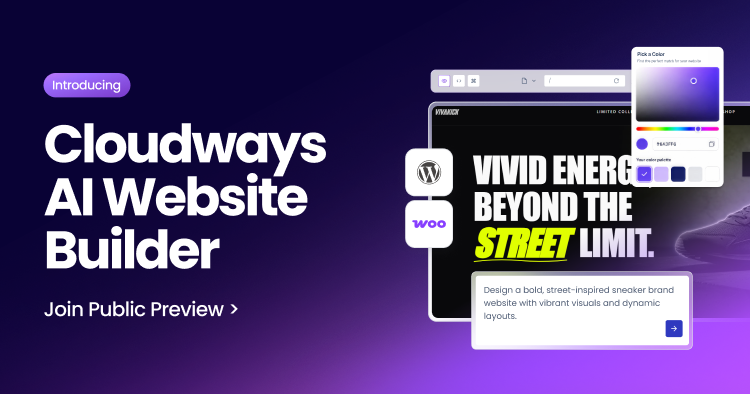
Cloudways will let you build a site with the help of AI or else have a developer make one to your precise requirements. For a WordPress or WooCommerce site, you can use Cloudways AI Website Builder to create the initial website and then bring in a developer later for custom development, complex functionality, integrations, or other advanced changes.
If a developer is building or customizing the site for you, the Cloudways platform is available for hosting; you have the say over the infrastructure and may use Linode, Vultr, Google Cloud, AWS, or DigitalOcean.
With Cloudways AI Website Builder, you can use a comprehensive prompt to put together a fully formed WordPress or WooCommerce site, complete with a responsive design, imagery, structure, and content.
From there, it is a matter of fine-tuning with the visual or code editor or via AI chat prior to making it live on Cloudways managed hosting.
With the Cloudways AI Website Builder, any prompt that alters your site will consume your AI Credits. The 3-day free trial comes with 1 AI website creation and 8 AI credits. To use those credits efficiently, it is recommended to bundle four or five related changes into a single prompt rather than putting in a separate submission for each.
There is no reason to think an AI-first method will prevent a developer from accessing the site later on. The site is built on standard Gutenberg blocks, so developers can get in and extend it at will.
The website can even be ported to a different host. It is a way of having the benefit of AI’s speed up front while retaining the developer access and full ownership the site will need down the line.
Build Your Website With Cloudways AI
Create your WordPress or WooCommerce website with AI, refine it, publish it on Cloudways managed hosting, and bring in a developer when deeper customization is needed.
Final Thoughts
One should not view the choice between an AI website builder and a web developer as a contest of which is the better of the two. It is about determining what will serve your current requirements without becoming a burden in the time to come.
Where speed, cost, and the convenience of running things are of prime importance, there is sense in starting with an AI builder. Yet when the project calls for something more technical or specialized, a web developer has much to offer.
Flexibility is what makes for the superior choice in the end. You may have a site assembled by AI and then call on a developer at a later date; conversely, a developer might use AI to get through the more monotonous work.
The aim is to put in place a platform and an approach that can keep pace with your website, sparing you from having to undertake a costly rebuild at some future point.
Q1: How long does it take to build a website in 2026?
With an AI website builder, you can have an initial site up and running in a matter of minutes. That said, to properly review the content, put the finishing touches on the design, and get it ready for launch will likely consume a few hours or days. If you go with a developer, expect the process to run for weeks or more, depending on the technical demands, testing, and feedback involved.
Q2: What is the best way to build a website in 2026?
That is a function of what the site needs to accomplish. An AI builder will do the routine stuff, be it ecommerce, forms, or your standard pages. For anything requiring custom workflows or complicated integrations, you would want a web developer. There are those who take a hybrid route so as to make use of a developer on the technical end while still benefiting from the speed of AI.
Q3: How much does it cost to build a website in 2026?
There is a good deal of variation in price according to the project and how you go about it. Professional development is billed by the hour or for the project as a whole. You will find most agencies putting their rates at $25 to $49 an hour these days, though the complexity of the design, experience, and where they are located can alter that number. AI builders operate on a subscription basis, monthly or annually. With the Cloudways AI Website Builder, you can sign up for a 3-day free trial that gives you 1 AI website creation and 8 AI Credits. Once that is over, the Pro plan is $7.99 per month and comes with 20 AI Credits for each site.
Q4: Is AI better than web development?
No, they serve different ends and are not substitutes. AI has its place in taking some of the manual work out of building a site, but a developer is better suited to the task when you require custom functionality or anything of a deep technical nature.
Q5: Are AI website builders good for SEO?
AI website builders can provide a solid base for SEO, provided the features are there: performance optimization, sitemaps, mobile responsiveness, and the means to put in your meta descriptions and titles. Ultimately, the quality of the content and backlinks, your technical SEO, and whether the site is serving the visitor’s intent will be what determines how you show up in the search results.
Q6: What are the disadvantages of website builders?
Website builders can restrict the control you have over the technology. The platform may not give you access to the code or third-party options you need for portability, and when the site is well established, you have to consider the subscription fees and being tied to the provider. This is not the case with Cloudways AI Website Builder. It generates WordPress websites, gives you access to WordPress Admin, and lets you customize the site with code, extend its functionality, or migrate it as your needs change.
Start Growing with Cloudways Today.
Our Clients Love us because we never compromise on these
[email protected]
Nisha is a technical content writer with a passion for translating complex technology into content that’s clear, practical, and enjoyable to read. With strong technical insight and a user-first mindset, she crafts guides that help readers understand and use modern tools and platforms.