Key Takeaways
- Effective leadership is built on emotional intelligence, collaboration, and continuous learning rather than authority alone.
- Leadership books offer practical frameworks and real-world insights that improve decision-making and perspective.
- The most valuable books are those that align with your current goals and challenges, not the number you read.
- Consistent learning from the right books can gradually strengthen leadership mindset and performance over time.
Everyone wants to lead, regardless of whether they fully understand the nuances and skills associated with it.
Mostly, people like the idea of leading, thinking it looks easy and allows them to do things their way and be the captain of the ship. And that’s how they fail. Leadership is not a one-man show. It is a collaboration, an understanding of the team, and requires EQ and empathy.
But where do you learn all of this? You may find online courses, or ask other leaders around you on how they manage it. But what better way than immersing yourself in books that offer the right advice. Reading the ones that are trusted and vouched for by thousands, offering actual actionable, real-life advice that can up your game.
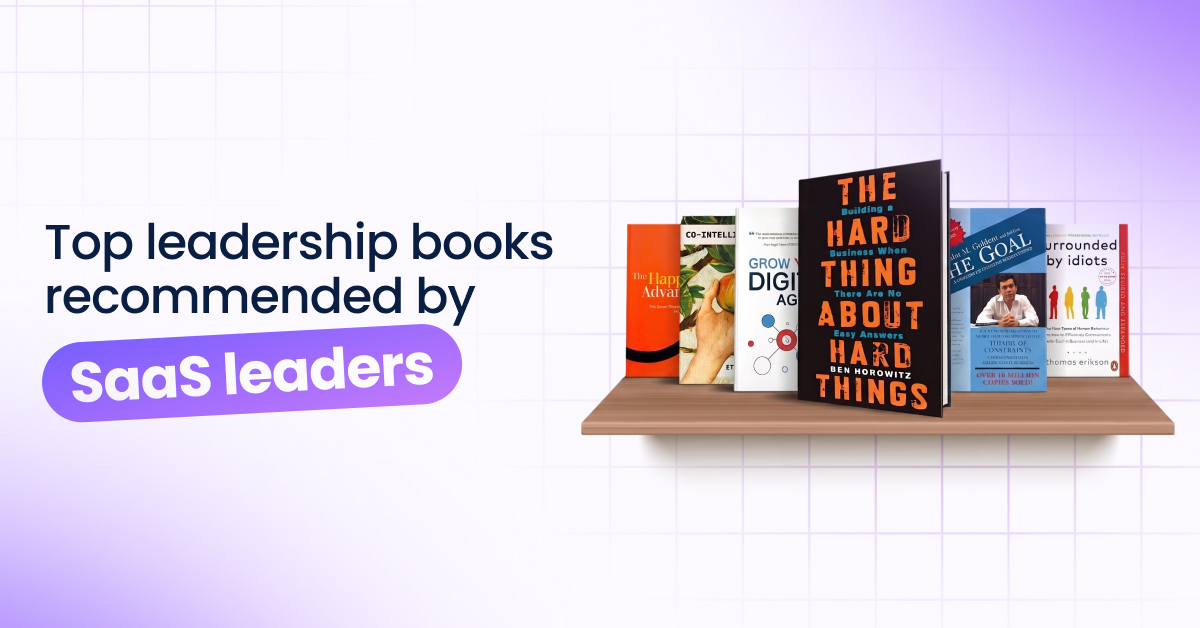
Finding the right book could be a hurdle. But you don’t have to worry about that as this blog features all the best leadership books to read in 2026. We also asked some leaders about their recommendations and what they learnt from their suggested books.
So, let’s discover what you need to add to your bookshelf if you’re becoming a leader soon or are already a leader trying to up your game.
- What the Right Book Can Do for Your Leadership
- The 17 Best Leadership Books of 2026
- Leaders Eat Last — Simon Sinek
- Dare to Lead — Brené Brown
- The Five Dysfunctions of a Team — Patrick Lencioni
- Never Split the Difference — Chris Voss
- Radical Candor — Kim Scott
- Extreme Ownership — Jocko Willink & Leif Babin
- Surrounded by Idiots — Thomas Erikson
- The Hard Thing About Hard Things — Ben Horowitz
- Turn the Ship Around! — L. David Marquet
- The Making of a Manager — Julie Zhuo
- Co-Intelligence — Ethan Mollick
- One Minute Manager — Kenneth Blanchard & Spencer Johnson
- The Happiness Advantage — Shawn Achor
- Humble Leadership — Edgar & Peter Schein
- The Effective Manager — Mark Horstman
- Grow Your Digital Agency — Robert Craven
- The Goal — Eliyahu Goldratt
- Final Thoughts
What the Right Book Can Do for Your Leadership
Some people may argue that books are a thing of the past. They are of the idea that alternatives like podcasts, online courses, etc., work better.
But books offer depth and permanence. They offer a more relatable connection with the author and are someone’s life’s work condensed. You read, underline what moved you or felt important, and then apply it to your real life over time.
The same goes for a leadership book. The right selection wouldn’t just offer you frameworks. It’d change how you see situations, respond to people, and how you make decisions under pressure.
The 17 Best Leadership Books of 2026
Our list of the best leadership books isn’t pulled from the trending titles on Google. It has been carefully curated after reading the reviews and is backed by recommendations from real leaders.
1. Leaders Eat Last — Simon Sinek

~ Source: goodreads
Simon Sinek is no stranger to bibliophiles.
In “Leaders Eat Last,” the American author and inspirational speaker explores the dichotomy of teams, where one grows by fully trusting each other and the other completely falls apart.
He presents the idea that the best leaders create safe environments (psychologically and professionally) for their teams.That sense of safety helps their teams drive real performance.
Sinek draws on military culture and corporate case studies to make his case. He also brings in science, specifically around cortisol and oxytocin, to explain human behaviour in teams. That’s what makes this book different from a generic leadership title.
Who Is It For?
Particularly useful for leaders who are struggling with team morale, retention, or trust issues.
Key Takeaway
Leadership is not about being in charge. It is about taking care of the people in your charge. When leaders prioritise their people over metrics and short-term results, performance follows naturally.
Goodreads Rating: 4.1/5
2. Dare to Lead — Brené Brown
~ Source: goodreads
Brené Brown makes the case that being tough or authoritative does not make you the most effective leader. In fact, it’s all about being courageous and vulnerable, which she categorises as a leadership strength, not a weakness.
The book covers how leaders can build trust, have difficult conversations, and create cultures where people feel brave enough to contribute fully.
Who Is It For?
Leaders at any level who struggle with having hard conversations, giving honest feedback, or building genuine trust within their teams.
Also relevant for anyone who confuses toughness with strength in leadership.
Key Takeaway
Vulnerability is not about oversharing or weakness. It is about showing up honestly even when the outcome is uncertain. That courage is what separates good leaders from truly great ones.
Goodreads Rating: 4.2/5
3. The Five Dysfunctions of a Team — Patrick Lencioni
~ Source: goodreads
Rather than giving straight-up advice like most leadership books, Patrick Lencioni focuses on storytelling, which makes it easier to remember the lessons. He also presents a pyramid model featuring five root causes that are as follows:
- Absence of trust
- Fear of conflict
- Lack of commitment
- Avoidance of accountability
- Inattention to results
And each dysfunction in this model builds on the previous one, meaning if trust is broken at the base, everything above it collapses.
Who Is It For?
Anyone who manages teams and is struggling to understand the reasons behind inconsistent performance, conflicts, and lack of accountability. Also for those joining or building a new team.
Key Takeaway
Team failure is rarely about talent or resources. It almost always traces back to trust. Fix the foundation, and the rest follows.
Goodreads Rating: 4.1/5
4. Never Split the Difference — Chris Voss
~ Source: goodreads
In this book, Chris Voss, a former FBI hostage negotiator, takes the negotiation techniques he used in high-stakes, life-or-death situations and translates them into practical tools for business and leadership.
He focuses on how negotiation has very little to do with compromise and is more about understanding the other person deeply enough to find a better outcome for everyone.
What makes this book different from typical leadership or negotiation books is the context it comes from. These techniques were not developed in a boardroom. They were tested in situations where failure was not an option. The backstory gives the advice a weight that most business books don’t have.
Who Is It For?
Leaders who negotiate deals, manage difficult conversations, handle conflict, or need to influence decisions without having direct authority. Useful at every level of leadership.
Key Takeaway
Listening is the most powerful negotiation tool you have. Most people negotiate to talk. The best negotiators negotiate to understand.
Goodreads Rating: 4.3/5
5. Radical Candor — Kim Scott
~ Source: goodreads
Kim Scott argues that most leaders fall into one of two traps. They are either too nice and avoid giving difficult feedback, or too harsh and deliver it without care.
Radical Candor sits in the middle. It is about caring personally for the people you lead while also challenging them directly. The book gives leaders a practical framework for giving feedback, having truthful conversations, and building teams that actually grow.
Scott developed this approach while working at Google and Apple under some of the most demanding leaders in the world. That real-world experience makes the ideas feel tested rather than theoretical.
Who Is It For?
Managers and leaders at any level who struggle with giving honest feedback without damaging relationships. It is particularly useful for new managers who tend to prioritise being liked over being effective.
Key Takeaway
The kindest thing you can do for someone you lead is tell them the truth. Avoiding difficult feedback does not protect people. It holds them back.
Goodreads Rating: 4/5
6. Extreme Ownership — Jocko Willink & Leif Babin
~ Source: goodreads
Jocko Willink and Leif Babin are former US Navy SEALs. They take the leadership principles they learned leading troops in the most hostile conditions imaginable and translate them directly into business leadership.
The central idea is simple but demanding. As a leader, everything that happens on your watch is your responsibility. No excuses, no blame, no exceptions.
What makes this book stand out is where the lessons come from. These principles were not developed in a conference room. They were tested in combat. That origin gives the leadership advice a level of trust and real-world weight that most business books simply cannot match.
Who Is It For?
Leaders who struggle with accountability, either their own or their team’s. It is also valuable for anyone who leads in high-pressure environments where decisions have to be made quickly and clearly.
Key Takeaway
The best leaders do not make excuses. They own every outcome, good or bad, and use that ownership to drive improvement. A team that sees its leader take full accountability will follow that example.
Goodreads Rating: 4.2/5
7. Surrounded by Idiots — Thomas Erikson (Recommended by Fatih Mehtap)
~ Source: goodreads
The author presents a personality framework built around four behavioural types i.e., Red, Yellow, Green, and Blue. Each type communicates, processes information, and responds to leadership differently.
Read this book if you want to understand why some people feel impossible to work with, and how to communicate rightly to get the best out of everyone around you.
The book’s simplicity and practicality makes it different. Most personality frameworks feel academic and overly complex, but Erikson strips all of that away. The ideas are immediately usable in real workplace situations, from managing challenging people on your team to recognising your own blind spots.
Who Is It For?
Leaders who find themselves struggling to effectively communicate with different types of people on their team. It is also useful for anyone who wants to understand their own behavioural tendencies and how those affect their relationships at work.
Key Takeaway
The problem is rarely the other person. Most communication breakdowns happen because we expect everyone to think and respond the way we do. Recognising different personality types makes you a sharper, more empathetic leader.
Goodreads Rating: 3.5/5
Recommended by Fatih Mehtap, VP Marketing at DigitalOcean
Fatih recommends this book for its ability to make you understand yourself as much as the people around you. As someone who identifies as a ‘Blue’ personality type, understanding those characteristics changed how he thinks and communicates with others.
“You are who you are, and there’s no point in wondering why. You’re fine no matter how you’re wired. No matter how you choose to behave, no matter how you are perceived, you are fine.”
8. The Hard Thing About Hard Things — Ben Horowitz (Recommended by Simón Credi)
~ Source: goodreads
The Hard Thing About Hard Things is not your typical polished, feel-good leadership book. It is a brutally honest take at what it actually feels to run a company when things are falling apart.
Written by Ben Horowitz, a Silicon Valley entrepreneur and venture capitalist, the man who first built and then sold a company for $1.6 billion. He writes about the parts of leadership most people avoid talking about. This includes laying people off, dealing with constant uncertainty, and making decisions where there is no clearly right answer.
Most leadership books are written in hindsight, when everything has already worked out. But Horowitz writes from inside the mess and does not try to make leadership look neat or predictable.
Who Is It For?
Leaders and entrepreneurs who are navigating uncertainty, building companies in fast-moving industries, or dealing with problems that have no obvious solution. It is especially for anyone leading in today’s AI-driven business environment.
Key Takeaway
There are no playbooks for the hardest problems. Leadership is about making tough calls quickly, staying accountable, and building teams that can execute under pressure.
Goodreads Rating: 4.2/5
Recommended by Simón Credi, CEO of 789.mx
Simón recommends this book for the way it reinforced what he learned the hard way as a CEO, that building a company is rarely about having perfect plans. It helped him embrace the reality that leadership is not about avoiding hard moments but navigating them with clarity, discipline, and resilience.
“Hard things are hard because there are no easy answers or recipes.”
9. Turn the Ship Around! — L. David Marquet
~ Source: goodreads
The author, L. David Marquet, was a US Navy submarine commander who inherited one of the worst-performing submarines in the fleet and turned it into one of the best. The book tells that story and distills the leadership principles behind it.
His central idea is that most leadership models are built on a leader-follower dynamic, where one person thinks and everyone else executes. He argues that this model is broken and replaces it with a leader-leader model where everyone on the team is empowered to think and act.
Like Extreme Ownership, the lessons come from a military context, which gives them a level of trust and real-world weight that most boardroom-born leadership advice lacks. But where Extreme Ownership is about accountability, this book is about empowerment.
Who Is It For?
Leaders who want to move away from micromanagement and build teams that can operate and make decisions independently. It is particularly useful for anyone leading large teams or organisations where one person simply cannot be across everything.
Key Takeaway
The goal of a great leader is not to create followers. It is to create more leaders. When you push decision-making down to the people closest to the work, both performance and engagement improve.
Goodreads Rating: 4.2/5
10. The Making of a Manager — Julie Zhuo
~ Source: goodreads
The author, Julie Zhuo, was a 25-year-old designer at Facebook when she was suddenly asked to manage a team. She had no management training, no playbook, and no idea what she was doing.
This book is the guide she wished she had. It covers the practical, day-to-day reality of being a manager, including hiring, giving feedback, running meetings, building trust, and figuring out whether you are actually doing a good job.
What makes this book different is how honest and personal it is. Zhuo does not write from a place of having everything figured out. She writes from the messy middle of learning in real time.
Who Is It For?
New managers or anyone who has recently stepped into a leadership role without formal training. It is also useful for experienced managers who want to test whether their instincts are actually serving their teams well.
Key Takeaway
Management is not a personality trait or a natural gift. It is a skill that can be learned. The best managers are not the ones with the most authority. They are the ones whose teams consistently do great work.
Goodreads Rating: 4.2/5
11. Co-Intelligence — Ethan Mollick (Recommended by Suhaib Zaheer)
~ Source: goodreads
Ethan Mollick is a professor at Wharton who has spent years studying how AI is changing the way we work. This book is not about the technical side of AI. It is about what AI means for the people leading organisations.
Mollick argues that the leaders who thrive in the next decade will not just be the ones who use AI as a tool. They will be the ones who fundamentally redesign how work gets done around it.
Most books about AI are either overly technical or written by futurists making predictions. Mollick writes from research and real experimentation. That makes the advice practical and grounded rather than speculative.
Who Is It For?
Leaders and decision makers who are trying to understand what AI means for their teams, their organisations, and their own role as a leader. It is particularly relevant right now as AI moves from a novelty to a core part of how businesses operate.
Key Takeaway
AI is not a replacement for human thinking. It is a collaborator. The leaders who treat it that way will have a significant advantage over those who either ignore it or hand everything over to it blindly.
Goodreads Rating: 3.9/5
Recommended by Suhaib Zaheer, SVP & GM at DigitalOcean
Suhaib recommends this book for the way it reframed how he thinks about AI, not as a tool, but as a collaborator. That shift in thinking, he says, is fundamental as businesses move toward more agentic systems.
“AI will not replace humans, but humans with AI will replace humans without it.”
12. One Minute Manager — Kenneth Blanchard & Spencer Johnson
~ Source: goodreads
Kenneth Blanchard and Spencer Johnson use a simple parable to deliver three core management techniques: one minute goals, one minute praisings, and one minute reprimands.
The idea is that effective management does not have to be complicated or time-consuming. Clear expectations, timely recognition, and honest correction done consistently are enough to build a high-performing team.
This book was first published in 1982 and has sold over 15 million copies. Its longevity is the point. The principles are so fundamental that they have outlasted decades of management trends.
Who Is It For?
New managers who are learning the basics of people management. It is also useful for experienced leaders who have overcomplicated their management style and need to strip things back to what actually works.
Key Takeaway
Good management comes down to clarity and consistency. People perform better when they know exactly what is expected of them, are recognised when they do it well, and are corrected quickly and fairly when they do not.
Goodreads Rating: 4/5
13. The Happiness Advantage — Shawn Achor (Recommended by Agathe Medvedieff)
~ Source: goodreads
The author, Shawn Achor, put years into studying the unique relationship between happiness and success. Based on his learnings, he challenges the conventional way people think about success, which is to work hard, get results, and then be happy.
He argues it is actually the other way around and offers practical, research-backed habits that leaders can use to shift their mindset and improve how they work and lead.
All the thoughts presented in the book are not mere opinion, but are backed by actual research, which adds to the credibility of the book.
Who Is It For?
Anyone who feels burnt out or is stuck in a negative mindset and wants to improve their own or their team’s performance and morale.
Key Takeaway
Small mental shifts and daily habits have a huge impact on performance. Train your brain to spot opportunities rather than obstacles and everything around you changes.
Goodreads Rating: 4.1/5
Recommended by Agathe Medvedieff, VP Marketing WordPress at group.one
Agathe recommends this book for the way it changed how she thinks about mindset. It helped her realise that you can train your brain to spot opportunities more easily, and that shift changes everything about how you work and perform.
“Success is not the key to happiness. Happiness is the key to success.”
14. Humble Leadership — Edgar & Peter Schein
~ Source: goodreads
Edgar Schein and his son Peter argue that the traditional model of leadership, where the leader is the expert, the authority, and the decision maker, is no longer fit for purpose in a complex, fast-moving world.
They make the case for a different kind of leadership built on genuine curiosity, deeper relationships, and the humility to admit you do not have all the answers. The book introduces different levels of relationships in the workplace and argues that leaders who invest in deeper connections with their teams get significantly better results.
Edgar Schein is one of the most respected organisational psychologists in the world. The fact that he co-wrote this with his son adds a personal dimension to the book that makes it feel different from a typical academic leadership text.
Who Is It For?
Senior leaders and executives who have built their careers on expertise and authority and are finding that style is no longer getting the best out of their teams. Also relevant for anyone leading through complexity and uncertainty where no single person can have all the answers.
Key Takeaway
The most effective leaders in today’s world are not the ones with the most knowledge or the loudest voice. They are the ones who ask the best questions, listen the most carefully, and build the kind of relationships where people feel safe enough to do their best work.
Goodreads Rating: 3.71/5
15. The Effective Manager — Mark Horstman
~ Source: goodreads
Mark Horstman strips management down to its bare essentials. No theory, no philosophy, just a practical, no-nonsense guide to the four core behaviours that make a manager effective. Those are getting to know your people, communicating about performance, asking for more, and pushing work down.
The book is built on decades of research and data from Horstman’s management consulting work. Where most leadership books are big on inspiration and light on instruction, this one is the opposite. It is almost entirely practical.
Who Is It For?
New and mid-level managers who want a straightforward, practical framework for managing people effectively without the fluff. Particularly useful for people who have been promoted into management without any formal training.
Key Takeaway
Most management problems come down to a lack of basics, not knowing your people well enough, not communicating clearly enough, and not delegating effectively enough. Master the fundamentals and everything else becomes easier.
Goodreads Rating: 4.3/5
16. Grow Your Digital Agency — Robert Craven (Recommended by Nick Bird, Commercial Director at Squarebird)
~ Source: goodreads
Robert Craven writes specifically for digital agency owners and leaders who want to grow their business without overcomplicating it.
The book cuts through the noise and focuses on the fundamentals, clear positioning, strong financial management, disciplined sales processes, and delivering consistent value to clients. It is a practical, no-nonsense guide for anyone running or leading a digital business.
What makes this book different is how specific it is. It is not written for every business leader, it is written for digital agency leaders.
Who Is It For?
Leaders and owners of digital agencies or service-based businesses who want to grow sustainably without losing focus on what actually drives commercial success.
Key Takeaway
Focus on the fundamentals and do them well. Too many agencies chase trends or over-engineer their operations. Strip things back and build a business that works commercially first and foremost.
Goodreads Rating: 3.8/5
Recommended by Nick Bird, Commercial Director at Squarebird
Nick recommends this book for the way it grounded him in clarity, commercial focus, and discipline early in his career. A concept that has always stuck with him is Craven’s 3% rule.
“Improve your business by just 3% in a number of key areas, and the cumulative impact is transformational.”
17. The Goal — Eliyahu Goldratt (Recommended by Anvar TK, Founder & CEO)
~ Source: goodreads
Eliyahu Goldratt wrote The Goal as a novel, following a factory manager given 90 days to save his plant from closure. But the story is a vehicle for something much bigger.
Goldratt introduces the Theory of Constraints, a framework for identifying the single biggest bottleneck holding a system back and fixing that before anything else. The lessons translate directly to any business, team, or operation.
What makes this book different from every other entry on this list is the format. It is written as a novel, not a business book. That makes it surprisingly easy to read and the lessons land harder because you experience them through a character rather than being lectured at.
Who Is It For?
Founders, operators, and leaders who are overwhelmed by the number of problems on their plate and are not sure where to focus first. Particularly useful for anyone running a fast-growing company where everything feels urgent at the same time.
Key Takeaway
Not every problem is worth solving right now. Every system has one constraint that is holding everything else back. Find it, fix it, and only then move on to the next one.
Goodreads Rating: 4.1/5
Recommended by Anvar TK, Founder and CEO
Anvar has recommended this book to several founder friends over the years. The Theory of Constraints framework stuck with him because it taught him to resist the pressure of fixing everything at once and focus on what is actually holding the system back.
“An hour lost at a bottleneck is an hour lost for the entire system.”
Ready to take your WooCommerce product variations to the next level?
Experience unparalleled performance, security, and customization options with Cloudways WooCommerce Hosting.
Final Thoughts
If you aren’t a voracious reader, then 17 books may look like a lot. But you don’t really have to read them all to become a better leader.
Shortlist the titles that resonate with your current professional goals and start with reading those books first.
And with World Book Day approaching on Apr 23, 2026, there is no better time to stop procrastinating and finally add that transformative read to your bookshelf.
So, which of these titles has earned a spot on your reading list? We’d love to hear your thoughts in the comments below.
[email protected]
Sarim Javaid is a Sr. Content Marketing Manager at Cloudways, where his role involves shaping compelling narratives and strategic content. Skilled at crafting cohesive stories from a flurry of ideas, Sarim's writing is driven by curiosity and a deep fascination with Google's evolving algorithms. Beyond the professional sphere, he's a music and art admirer and an overly-excited person.