EXPLORE CLOUDWAYS
Experience lightning-fast loading times and seamless platform
View Demo >PRODUCTS
CLOUD PROVIDERS
SUPPORTED APPS
WHO WE SERVE
PARTNERSHIP PROGRAMS
Lifetime deal: 75% OFF
Advanced Support
POWERFUL FEATURES
DISCOVER
WHY CLOUDWAYS
 Read Case Study >
 Jesse Tutt
Founder & CEO

The Prepathon 2026 keynote unveiling Cloudways Velocity, a new managed Node.js hosting platform, with a live demo of deploying a full-stack app from GitHub to production.
🎙️ Speakers
▸ Suhaib Zaheer — SVP, Cloudways
▸ Ali Ahmed Khan — Senior Director of Product Management, Cloudways
▸ Host: Danish Naseer — Cloudways
✨ Key Takeaways
✦ Cloudways is expanding beyond WordPress and PHP into modern application hosting with Velocity.
✦ Velocity is managed Node.js hosting: connect a repo and every Git push rebuilds and redeploys.
✦ It sits between restrictive serverless and unmanaged VPS, always warm with no cold starts via Nginx and PM2.
✦ Security is built in by default: WAF, DoS mitigation, malware protection, and Cloudflare Enterprise CDN.
✦ Pricing is flat and predictable, one price per server from $120, with multiple apps hosted per server.
✦ As AI speeds up code creation, the new bottleneck moves downstream to deployment and operations.
✦ Attendees can claim $20 in free hosting credits to start with Node.js hosting.
Danish Naseer: Hello everyone, we are back with Prepathon 2026. We are live. I am Danish from Cloudways and I am really excited to have you all here with us today for Prepathon. We need to discuss a few things with you once we start the sessions. Over the next two days we are going to talk about something that is changing very quickly: how we build, how we ship, and how we scale.
As we know, AI is changing the way we build websites, and developers are building faster. We know AI agents are not only answering questions, but they are also working with tools, they are working with your systems, and sometimes they behave like a team member of your team. And the way we deploy and run these applications, this is also changing. This is all about the Prepathon. Over the two days we have experts from the e-commerce industry, digital agencies, we have developers, we have subject matter experts who will give you the real talk, give you real scenarios that you can build in your business and learn a few things from this Prepathon.
Before we start, let me quickly see if you can give us some thumbs up. I can see some reactions on the screen to see how many people are joining, and if you can just type the city name or the country name from where you are tuning in. So I can see some of the chats here as well. People are joining from Toronto. Some people are from India. Kishan from Nepal, Retika from Toronto, Blake from Chicago. Welcome Blake again on Cloudways events. Alexander from UK. We have people from Indonesia. We have someone from Egypt. We have Jason from Texas. So I can see people all around the world.
Before we move on to the first session, I would like to inform you that we have companies and people from different communities. We have people from OpenClaw, we have people from WooCommerce, Amazon, and other companies. So it’s your chance to ask questions to those guest speakers and learn from them. Before we move on, I would like to give a shout out to our proud partners. We have WP Umbrella, Barn2, Next Big Win, we have Agency Mastery, and we have Infinite Uploads as well, E2M as well.
Not only the sessions and the panel discussions, we are live, we have some activities, we have challenges and giveaways as well. So it is your chance to participate in the activities and win some big prizes. We have a leaderboard as well. You can ask questions, you can interact on the booth, on the chat, and you can earn points. And at the end of the event on day two, we will announce the winners as well. So make sure to interact in the chat. Make sure to visit the booth as well. We have some good offerings as well. Our partners also set up the booth. So if you want to avail their offers, feel free to visit the booth.
All right, we are starting the Prepathon with the first session. The first session is the keynote session. It’s Deploy with Velocity, and I would like to invite two of the members from the Cloudways team. First I would like to invite Suhaib. Suhaib is the SVP of Cloudways and he leads the managed hosting business. And the second person is Ali Khan. He’s the Senior Director of Product Management. Hey, Suhaib.
Suhaib Zaheer: Hey Danish. Always great to be here. Looking forward to the session today.
Danish Naseer: Perfect. So as we know, we are starting with the keynote of the session. The first session is Deploy with Velocity, and there is something for the live attendees as well. So we can start with a thought. Cloudways has been helping businesses build and run their websites for years, and we have seen the web change quite a bit during that time. So from your perspective, what have you seen changing in the developer ecosystem, and why does this make now the right time for Cloudways to expand into modern application hosting?
Suhaib Zaheer: Well first, good morning, good afternoon, good evening depending on where you’re joining us from. It’s always great to have you all with us for Cloudways Prepathon, and this year especially today it’s such an important milestone for us because we’re officially expanding what Cloudways stands for. For years, millions of websites and businesses around the world have relied on platforms like Cloudways to make hosting simpler. And many of you know that Cloudways, we built our reputation around WordPress and PHP by taking away much of the complexity of infrastructure and really allowing our users and customers to focus on what they actually wanted to build.
And the way that software is being created today is changing incredibly quickly. And Danish, to the question that you asked, why now, and what are we doing today, and how are we addressing that? Well, if you think about the way developers are building, you can go from an idea to working code faster than ever, and everybody knows that AI coding tools, modern frameworks, APIs, the open source technologies, they’ve really compressed development cycles. So now things that used to take weeks or months can now happen in days, sometimes in hours.
But there’s one interesting problem, and while we’ve made building that software dramatically easier, which I think everybody could attest to, getting that software reliably into production can still be what we view as unnecessarily complicated. And look, our view has always been that developers shouldn’t have to become infrastructure experts just because their application is successful. They shouldn’t have to choose between a platform that’s incredibly simple but becomes expensive or restrictive as they scale, or raw infrastructure that gives them full autonomy and control but then requires them to operate everything themselves. We know there’s a better middle ground.
We’ve been deploying a product that’s actually helped customers build, developers build, and that’s why today we’re officially announcing Cloudways’ entry into modern application hosting with the announcement of Cloudways Velocity, which is our new managed Node.js hosting experience. The reason we’re so excited about that is Velocity is going to take the same philosophy that made Cloudways wildly successful years ago, which is the whole simplicity, management of the infrastructure, performance, freedom of choice, all the things that made Cloudways great. We’re going to take all that and bring it to the next generation of applications and builders.
So now it’s not just about WordPress. Whether you’re building an API or a SaaS product or an internal tool or an AI application, whatever it is that you want to build, even if that didn’t exist six months ago, our goal is simple. Now you’re going to build an application, and then Cloudways should make it extremely easy to get that into production and then keep it in production as it scales. And we want to make that incredibly easy for all of our developers. So today’s Prepathon, that’s the big announcement. We’re super excited to jump into the details, which we’ll do in just a moment. And that’s where that journey begins. We’re really excited to bring this to market and we know this is going to have a profound impact for developers and builders across the world.
Danish Naseer: Awesome. I think we have prepared a video as well just to launch the Node.js hosting. So I would request the team to play the video. Once we are done with the video, I have a few questions for Suhaib and then we will continue the conversation.
[Launch video]: Introducing Cloudways Velocity. Managed Node.js hosting for modern applications and workflows. Deploy, run, and manage production workloads from one platform. Whether you’re a startup outgrowing serverless, a developer moving a prototype into production, or an agency leaving a raw VPS behind, you don’t have to put up with unpredictable bills, application timeouts, or servers that constantly need your attention. Velocity gives your applications a managed home. Simply connect your repo, and every Git push rebuilds and redeploys automatically. SSL, backups, and security are handled for you. Malware protection, Cloudflare Enterprise, and a web application firewall are included by default, and the infrastructure is managed for you with clear visibility into application performance, all with flat, predictable pricing. Start shipping awesome apps with frameworks you already use. If it runs on Node, it runs on Cloudways Velocity. Deploy your apps now.
Danish Naseer: That’s awesome. Congratulations to everyone, to the Cloudways team for the Node.js launch. So I can continue the conversation with you. I have a few questions. As we know, Cloudways has historically been associated heavily with WordPress and PHP. Why is now the right time for Cloudways to make a serious move into modern application hosting?
Suhaib Zaheer: Well look, WordPress has always been and will continue to be incredibly important to Cloudways. We’re not moving away from that at all. We’re just expanding the problem that we’re capable of solving. And I want to be very clear about that. This is not a moment in time where we’re saying, hey, WordPress is a thing of the past. It’s not that at all. It’s going to continue to be an incredibly important component of what we do.
But I think the interesting thing is that the core problem between what we solve for WordPress and what we’re solving now with this new launch, it’s actually very similar. So we became successful because we made that powerful cloud infrastructure much easier to consume without really forcing customers to manage everything themselves. And we see that same need emerging for modern application developers as well. That part of the equation hasn’t changed. So Node.js, APIs, SaaS products, agentic workflows, they’re all becoming a much bigger part of what people are building. And with the advent of AI, it’s dramatically increasing the number of people who can actually build software in the first place.
And a lot of times those folks don’t have a ton of experience with infrastructure. And so our view is that the addressable market for developers is expanding, and at the same time the complexity between “I built something” and knowing how to reliably run that in production is becoming more visible. And that’s the problem that we’re trying to solve. It’s a very natural problem for Cloudways to solve, and we’re simply augmenting what we’ve already done with WordPress in this new space.
Danish Naseer: Awesome. Velocity is about more than raw infrastructure speed. What does velocity mean from a developer’s perspective, if you can answer that?
Suhaib Zaheer: Yeah, I mean look, to us velocity is not necessarily just about fast and performant. It’s really about developer velocity. It’s not just infrastructure performance. It’s about shortening the distance between having that initial idea and then having something running reliably in production, and then being able to iterate on that just as quickly. And I think that’s becoming extremely important, maybe even more important than it ever has been in the AI era, that now someone can build an application in a few hours but then it takes another day, maybe longer, to configure the infrastructure, deploy it, secure it, monitor it, etc. We’ve just moved the bottleneck.
And so velocity is about removing that friction across the entire life cycle for developers and builders. The deployment should be simple. Monitoring, backups, security, all of that should be built in. Scaling shouldn’t require you to suddenly become an infrastructure expert. And as I mentioned earlier, a lot of the folks who are using these AI tools to build these products, they don’t have that infrastructure expertise. So velocity shouldn’t come at the expense of control or economics. Developers should be able to move really fast when they have their first idea, they want to deploy it to production, and they should do so in a way that still gives them that control and the cost structure they need as their application scales.
And that’s another important thing that I want to pause on for a minute, is that it’s not just about that initial deployment. It’s what happens when the application starts to become successful. And so the ultimate measure of velocity isn’t just how fast the application is, it’s really how fast can I build, deploy, iterate, and scale. And that’s really what velocity means to us at Cloudways.
Danish Naseer: And in my introduction, as I said, AI is dramatically increasing how quickly developers can create software. So if code creation becomes faster and cheaper, where does infrastructure become the new bottleneck?
Suhaib Zaheer: Well, that’s exactly the opportunity we see. AI is letting people create applications in hours instead of weeks. Think about that. Within hours you can take your idea, bring it to life. But the challenge is that what we’re seeing is that sometimes people are spending the next several hours, in some cases days, figuring out the infrastructure side. And now suddenly you just move that bottleneck, and that feels incredibly expensive. It’s like you’re just pushing the problem further downstream.
And we’re going to see dramatically more software created. I think everybody unanimously can agree that with the tooling and technology available to all of us today, dramatically more software is going to be created. More applications, more experiments, more APIs, more agents, more everything. And many of those things are going to be created by people who don’t have decades of infrastructure experience. So for us, this advent of these technologies and being able to use AI to create these apps, the bottleneck is really moving downstream, and the bottleneck becomes deployment, reliability, security, observability, scaling, cost management, etc. And so the infrastructure platforms, we believe, that are going to win in this environment are going to be the ones that make the complexity completely disappear but without taking control away from developers. And that’s exactly why we’re so excited about this launch.
Danish Naseer: Awesome. And what do you think the next generation of developers will expect from their hosting platform that previous generations didn’t?
Suhaib Zaheer: Well, I think they’ll expect infrastructure to feel much more like a product, and increasingly like an intelligent product. And let me explain a little bit what I mean by that. Previous generations of developers accepted that getting software into production meant assembling a lot of the pieces themselves. I think this next generation of folks won’t have that same tolerance, especially when you think about how AI is helping them build applications in the first place. So they’ll expect to go from code to production almost instantly. This is a big change that’s happened in the last several months and maybe the last year. They’re going to expect all of the monitoring and security and backups and all that to be built in.
And increasingly, we believe that they’re going to expect the platform not to just tell them when something’s wrong, but to sort of understand what’s happening, recommend what to do, and then eventually take action on their behalf, so they don’t even have to worry about it. And I think that’s fundamentally what we are seeing from our own customers, what we’re hearing from developers in the community. We’re already starting to see that evolution with our own users as well. For example, with Copilot on our WordPress platform, we’ve already moved beyond traditional monitoring towards proactive identification of issues, proactive investigation of issues. In many cases, we’re now helping developers resolve those autonomously or even automatically.
So I just share that as a glimpse of what I mean when I say the users are going to expect a different level of intelligence. It’s like, hey, I want to spend my time building applications, not managing infrastructure. And now that infrastructure has to become extremely intelligent, and hosting platforms like ourselves, or the ones of the future, they shouldn’t just be a place where you park your application and it runs. It should be intelligent. It should help you operate. It should help you remove those mundane tasks that folks are still having to do on a day-to-day. And I think ultimately that’s the mindset of the next generation of developers. They’re going to look at every manual infrastructure task and say, why am I still doing this myself? Again, we’re hearing that from our customers, and that’s exactly the reason why we’re going down the path that we are.
Danish Naseer: Awesome. And I think this is the right time we can have the demo as well, how the Node.js hosting looks inside the platform. So we have our Senior Director of Product, Ali Ahmed. Ali, we would like to see how the Node.js hosting looks inside the platform. If you can give us a demo so that attendees can see how they can deploy, how easy it is to deploy, and then we can discuss how they can avail that $20 hosting credit to start free with Node.js hosting.
Ali Ahmed Khan: First of all, thank you Danish, thank you Suhaib, and thank you to all the attendees here. Really excited and glad to be part of this event. I’ll quickly share my screen and then we can have the demo. Can you guys hear me? I hope the internet does not act up. This is not the right moment. Okay. So before we dive into the demo, I just wanted to quickly double down on what Suhaib mentioned. Let me in fact share the presentation in slideshow mode. So I just prepared this quick slide and I just want to double down on what Suhaib mentioned about Cloudways Velocity and the direction that we are going towards.
What is Cloudways Velocity? Very clearly, it’s a managed platform for running full-stack production Node.js applications. It can be backend APIs, headless runtimes, etc. And the dilemma has been that if you’re a Node.js developer or a modern AI builder, deploying to production means choosing between one of these two extremes. On one side you have serverless platforms which are very easy to start with but can become very quickly restrictive, unpredictable, and expensive at scale. And on the other hand, you have the raw VPS infra that gives you control but also leaves you responsible for managing servers, the patching, backups, OS upgrades, etc. What Velocity does is it eliminates this trade-off. With Velocity you get the flexibility and predictable economics of VPS infrastructure without taking on the operational overhead that normally comes with it.
So if I talk about the primary themes that were the reason behind building Velocity, the first one was there are no cold starts to worry about. Velocity simply runs on persistent servers with a preconfigured Nginx and PM2 stack, where PM2 keeps your Node processes alive and restarts them on boot, so the application does not spin down when it’s idle. The second one is managed and secure, and Suhaib talked about it. Velocity eliminates the operational overhead like OS patching, certificates, automated backups, caching, etc. Everything runs without any sort of intervention from the user side. And security is included rather than sold separately. You get WAF, DoS mitigation, malware protection, Cloudflare Enterprise CDN, all of this stuff to ensure security of your application, of your infra, on all the Velocity plans.
And the third was flat and predictable pricing. So just one monthly price per server which starts at $120. We’ll go into the platform and see the Velocity plans on offer as well. On these plans you can host multiple applications on the same server. So the real cost per application, if you look at the $20 plan, it lands at around $4 at list price, and there are no additional costs. There are no hidden costs at all. And plans can be upgraded or downgraded any time without any sort of locking.
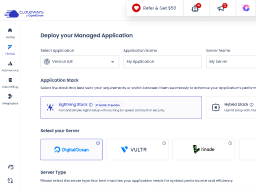
So I’ll move to the next slide and we’ll share a pre-recorded demo video. Before we start the demo, what I want you guys to look for is how simple and how easy it is for a user, a developer, or a modern AI builder to deploy code onto the server and the application on Velocity. So this is the homepage of the platform. In the main left navigation, you’ll see Cloudways Velocity. When you click it, you see this welcome landing page where you see all the key features we talked about. You get all of this stuff out of the box on all the Velocity plans. When you click Get Started, we have five plans over here. Starting price is $20 a month and that plan hosts five applications. You can upgrade or downgrade these plans anytime based on your needs. You can simply select the plan, choose the disk space, and then continue. Here you can choose the disk space to your liking and based on the needs of your application. And when you click continue, you just give your server a name. You select the location.
And this step is pretty important because this is where you connect the repository where you have the code which you want to build the application on. So in this case, I’ll simply connect GitHub. I’ll connect and authorize. And once done, it automatically shows me the workspace and all the repos inside the workspace. For this demo, I’ll simply select the dummy React application. And once I do that, this is a pretty important page where it pre-selects the framework. It shows me all the branches that I have in the repo. It pre-selects the Node latest version, which is 24. I can edit the build and output settings over here to my liking. In this case, I’ll just move it from Yarn to npm, and then I can set the environment variables here. We’ll get back to it later once we are at the stage of connecting the database. And if you want, you can add a temporary domain as a part of this process as well.
Now, deploy. When you hit this, basically two things happen behind the scenes. First, the server that you selected, or the plan you selected, the server starts getting provisioned, and as soon as it’s provisioned your application starts to get built. And on this screen you can see all the deployment settings, and then once the log stream starts to establish you will see all the build logs in real time, which are pretty useful. Here they are. It tells you everything. If your deployment fails for some reason, these logs are very helpful in identifying and troubleshooting what actually went wrong. In this case, it’s a success. So I’ll go to the application listing page. And this is the overview page where I’ll see the details for the latest deployment that I have made on this application. Again, the same build logs. Here I can start or restart the PM2 service. I can configure the application backup. I can add an application domain. In the access details, we have PostgreSQL and Supabase. So these are the two native databases that we support out of the box. But you can connect external databases as well. Later on in this demo, we’ll connect PostgreSQL.
Deployment management. This screen is pretty important because this is where you manage all the deployments from. If you want to deploy a new change, or if you want to change the branch for the deployment, this is the page that you will use for that. Now this is the application that I pushed the code for from my GitHub. It’s a pretty simple to-do list application. But when I click the application URL, I’ve not mapped the domain yet. We can do that later on. This tells me that okay, this application is now online. It’s not on my actual domain. But it also shows me that something is wrong with the database here. So we’ll see the API status and see if everything is fine on the API front. Everything seems fine over here. But when we check DB health status, it shows me that DB is not connected. So we’ll quickly go now and install PostgreSQL on this application. For that I’ll simply go to the access details page and I’ll connect PostgreSQL. Now this step is important. Once you decide to add PostgreSQL on your application, it’s an irreversible step. But when you do that, all the environment variables that are required are automatically generated and added in the environment variables tab, which we’ll see in a bit. So I’ll proceed here.
Now let’s go into the database manager and see what we have up there. No tables. It’s a new DB. So I’ll quickly create one where we’ll save the items in the to-do list. And these are all the environment variables which are created when I installed the PostgreSQL database. And then once the database is connected, we’ll simply go and see everything is working fine. Now the next step naturally is to just take this application live, map my domain, install the SSL certificate, and then just take it live. So it’s really easy. I will quickly add some tasks over here in the to-do list item and see those will be getting reflected in the table I created on PostgreSQL. So that’s pretty much it for the demo.
I’m happy to give a detailed demo to anyone who wants a deep dive into Cloudways Velocity. Feel free to reach out to us through our support team and we’ll schedule a detailed demo. But you see how easy it is to push your code to production through Velocity. And to get you started, we are offering $20 free hosting credits for all the attendees over here. So just scan this barcode and claim your $20 credits.
Danish Naseer: Thanks Ali for the demo, and congratulations to the Cloudways team for the Velocity launch. I have a few questions. We can discuss those questions and we have 10 minutes, then we have another session lined up. Starting with my first question: we have seen developers move from traditional hosting towards managed platforms because they want speed and simplicity. So what are developers still missing when they make that trade-off?
Ali Ahmed Khan: Well, in my opinion, the biggest trade-off that comes with speed and simplicity is the cost of control, visibility, and predictability. A developer or an AI builder can get started quickly on many modern platforms, serverless platforms, but once the application becomes real, they still need the basics like runtime control, deployment visibility, the logs that we were seeing over there in Velocity, environment management, security, backups, etc. And on the other hand, the traditional VPS hosting gives you control, but it pushes too much operational work onto your shoulders. So what developers, in my opinion, are still missing is a middle ground. They want the experience to feel simple, but they do not want the platform to become a black box for them. So that’s what Cloudways Velocity solves for the customers.
Danish Naseer: Awesome. And what exactly are you trying to solve with Cloudways Node.js hosting that developers can’t easily solve with the existing alternatives?
Ali Ahmed Khan: Well, part of it was covered in my previous answer, but I’ll just double down on this one a bit. So you talked about alternatives. Let me be fair to the alternatives first because they’re all good at something. Definitely, that’s why they’re out there. A raw VPS is cheap and completely predictable. You also own every patch, every certificate, every other detail. You get predictability and control, but the problem is nothing is managed over there. Then we have a serverless platform that gives you a genuinely excellent developer experience, and really some of those products are a pleasure to use, but you have to accept cold starts and you have to accept the unpredictability of the cost. Then we have hyperscalers which can do absolutely anything, and almost nothing about it is simple to run it well. You budget a platform team and you have to budget significant infra costs. So hyperscalers are capable but not accessible to a small startup. What nobody was putting, or almost nobody was putting, in one box was a fully managed, always warm, enterprise-secured solution like Velocity for modern AI builders and not just developers, that does not give any bill shocks. And that’s important, and that’s what Cloudways Velocity actually is.
Danish Naseer: Awesome. And developers want to build something with APIs and SaaS applications, to AI-powered apps and agentic workflows. How did that influence the product decisions behind Velocity?
Ali Ahmed Khan: Well, the biggest influence was recognizing that the way developers build applications has changed, and that’s what Suhaib was talking about as well. You can create an application or a website or any sort of tool or any workflow in a matter of hours, if not minutes now. But the thing is, what has not changed is the complexity of running them in production. That has not gone away. So today a developer might be building a traditional API or a SaaS product or anything using tools like Cursor, Claude, Codex, or any vibe coder. The possibilities have expanded dramatically, but getting from idea to working code is still pretty difficult. So building an application, I think, in today’s day and age is only half the journey. Getting it into production, keeping it secure, that’s important, keeping it secure because we have been hearing a lot of security issues out there with the advancements in the AI models, and then scaling it reliably, that is where the complexity begins. So these are the things that shaped our thinking behind Velocity.
Danish Naseer: Yep. Awesome. Ali, I can see there are multiple technical questions in the Q&A session. So I would request you to stay active in the chat and the Q&A session because people are asking about security and other things as well. And again, it was nice talking to you both. We have another session lined up. So first of all I would thank you both, and good luck with the Velocity launch. That’s it from the keynote session. Thanks so much Suhaib and Ali. We have another session coming up with Luca and Maud: Your AI wrote the code, now who owns it? So we will be back after a short break. Don’t go anywhere. We are back with a panel discussion with Luca and Maud on Your AI wrote the code, now who owns it. We will be back.
Answer a few questions, and we'll present you with a personalized tour of the Cloudways platform based on your answers.