EXPLORE CLOUDWAYS
Experience lightning-fast loading times and seamless platform
View Demo >PRODUCTS
CLOUD PROVIDERS
SUPPORTED APPS
WHO WE SERVE
PARTNERSHIP PROGRAMS
Lifetime deal: 75% OFF
Advanced Support
POWERFUL FEATURES
DISCOVER
WHY CLOUDWAYS
 Read Case Study >
 Jesse Tutt
Founder & CEO

The opening keynote of Prepathon 2025, on how AI, trust, and speed are reshaping e-commerce, and how Gen Z and Gen Alpha are redefining the rules for the next decade.
🎙️ Speakers
▸ Fatih Mehtap — VP Marketing, DigitalOcean & Cloudways
▸ Host: Moeez — Team Lead, Community Marketing, DigitalOcean
✨ Key Takeaways
✦ AI has become the new gatekeeper in retail, filtering and recommending products, sometimes without the brand involved.
✦ Table stakes still matter: load time, checkout performance, and a cohesive experience across every device and channel.
✦ Speed is non-negotiable, obsess over it to eliminate friction, especially at checkout.
✦ Win the next wave of buyers with social proof, creators, and showing up authentically in communities.
✦ Gen Z rewards trustworthiness and clear values, and Gen Alpha, the AI-first generation, will push commerce further.
✦ Buyers now research and decide inside AI tools, and Shopify and OpenAI’s instant checkout brings buying into ChatGPT itself.
✦ Sellers can use AI for trend research, reducing returns through personalization, and dynamic pricing.
Moeez: Hey everyone, what’s up? My name is Moeez and I welcome you all to this year’s Cloudways Prepathon. I’m so excited to be your host this year because we have three days of action-packed inspirational learning for all of you so that you can scale your e-commerce stores for this Black Friday season and beyond. I want to see people, I’m already seeing people joining in. I can see Sidra, Edison, Phillip, people joining in from Mauritius, India, United States, Johannesburg, Mexico. So please make sure that you keep on commenting from where you’re joining from. It generates engagement and it’s also good for the event. So thank you so much for joining the event everyone.
This year’s Prepathon is about future proofing your online stores for the next generation of buyers, because we have the Gen Z’s who are gathering this purchasing power so that they can buy in the next 5 to 10 years, and then we have Gen Alpha who will be in the same position in the future. So this year’s Prepathon is all about making sure that your online store is in position to survive and to sustain and to increase profitability.
Before we begin, before we move on to the first session of the day, I want to make a few quick announcements. The first one is that we have, apart from the sessions, apart from the panel discussions, apart from the expert insights, we have a fun giveaway as well, and that means the most engaged participant of the Prepathon will get a $50 Amazon gift card by the end of day three. So make sure you keep on commenting, you keep on asking questions, you answer polls so that you are in line to win that Amazon gift card. Apart from that, I want to give a huge shout out to our partners who have made this event possible. We have Brizy, WP Bakery, Omnisend, Style Mix, Monster. Each of these partners have made this event possible by spreading the word out and helping us organize this event.
And then lastly, we are opening our day one with a keynote that will take you through what this Prepathon is about, what can you expect over the next three days, and yeah to just build up some hype and excitement for that I have a very special guest with me who is going to take you through the Prepathon theme of this year and to tell you why exactly are we doing this event this year and what are we focusing on. So if I can have on stage Fatih Mehtap who is the VP, vice president of digital marketing at DigitalOcean and Cloudways. He is an awesome guy. He’s joining us all the way from the UK. And Fatih, it’s so awesome for you to be here. How are you feeling about Prepathon this year?
Fatih Mehtap: All good, Moeez. Thank you for the warm intro. Super excited to be here and I wanted to say good morning to all of you, or maybe good afternoon or good evening depending on where you are and where you’re joining us, depending on the time of day. So you’re all very welcome. As Moeez pointed out, my name is Fatih and I have the privilege of kicking off Prepathon 2025 for this year.
Moeez: Awesome. So, Fatih, I think without further ado, let’s get on with the keynote. The floor is yours.
Fatih Mehtap: Sounds good. Thank you, sir. Okay. So, before I dive in, I’d like you all to just indulge me for just a moment. Think about the last purchase you made online. Maybe it was something like, I don’t know, online groceries you maybe already had on a repeat order, or something equally mundane that you didn’t really have to think much about and were just sort of operating on autopilot. But what if the purchase was something more substantive, or something you would have spent a considerable amount of your income on?
For example, if I was a betting man, I would probably say that you are likely to have done a couple things. You probably read through some reviews online. Maybe you watched an unboxing video or a haul video or two. You may have scoured social for buyer-generated reviews and most certainly, like we all do, trolled through the comment section for further insight. Not only am I pretty certain you would have done all of these things, but it’s also highly likely you would have used AI somewhere throughout that process. And what I can say to you all is you’re by no means alone.
I’m someone who represents the Gen X cohort, and as far as consumer evolutions are concerned, I’ve definitely had a front row seat to the extent of what sort of transformation we’ve seen. I remember my parents’ generation were very much invested as consumers in seeking affordability, and for them it was all about having choice, a choice of goods, choice of services. For my generation it was probably all about convenience and access. We are after all the OG fast generation, whether that is fast food or home delivery or convenience, all of that.
But then millennials came along and they benefited from what the notion of, again, fast could really mean in the era of, I guess, web shopping and the internet and mobile apps and Amazon and Alibaba and Flipkart and all the others that came after it. And as merchants and sellers, just when we thought we were getting to grips with all of that possibility, along come social selling, creator economies, fragmented commerce experience, and then shopper cohorts that really have completely wildly different expectations from brands from what preceded it. And then to top it all off, we’re having to reinvent and re-transform once again as search and discovery changes have been completely transformed through the lens of AI.
In fact, AI has become the new gatekeeper in retail. And what it’s doing is it’s actively filtering and recommending products to consumers out there without even the involvement of brands sometimes. But we’re definitely not throwing out the baby with the bathwater. I think there are table stakes qualities that are coveted by online shoppers that should matter enormously to any site owner or any online brand that has an e-commerce store. Things like site load time, page browsing speed, checkout performance, multi-form factor optimization for mobiles, tablets, smaller form factors, laptops, desktops, UI best practices. These are all priorities our online users have come to expect of us as table stakes. They just see it as a given.
And they want all of those facets. They want the experience and they want it to be delivered in a highly coordinated, highly cohesive way. And so when you think about that sort of joined up experience, you have to take it within its stride so that every decision you make is aligned to not just where you are in that point of time, but being able to meet consumers where they want you to. So for example, there’s no point investing in paid social to promote a specific product or a collection if you’ve already sold out on your e-store and somebody lands there and guess what? They can’t buy. That’s not a great experience. If you’ve just emailed me an email discount offer or promo code, and I happen to be walking past your store, I should be able to shop and redeem it there and then if I decide I go in, not to be told that, oh, well, actually, that discount code was only something that could be applied online and for online purchases. So, really cohesion and that sort of table stakes is what I think a lot of consumers are looking for from the overall consumer and shopping experience.
But talking of table stakes, if there’s one aspect of the user journey that I think you simply have to nail as a non-negotiable, it’s speed. A few quarters back, we published a Cloudways report on the 2-second rule. That’s what we called it, where we talked about the differential between what happens when your site isn’t optimized for speed and performance. Well, what happens is this, the stats that you see online. Consumers are unforgiving. Don’t give them a reason to walk away, especially if it’s something that’s wholly within your control. Choices around how you host, where you host being one of them, of course. And in case you missed the report and you’re interested in reading more about it, feel free to download it via the link on the screen through the QR code that you’re seeing.
In fact, speed is something that you should obsess over and really focus on in order to be able to eliminate friction. And eliminating friction has never been more important than at the checkout process. It’s where every millisecond in the process matters. I think we all get this and we all understand it. I’ve definitely had those experiences where poor UI design and poor QA has meant that that submit button is somehow hidden behind something else in the screen. It doesn’t matter if you rotate your mobile phone into landscape, it’s still rendering it useless. Or when you’ve just signed up to a newsletter because you want to get a discount code because you’re on the store about to shop and buy something but you want to apply the discount code, but guess what, you have to first authenticate your account through an OTP, but the OTP verification never lands in your inbox. I think we’ve all been there and we’ve all had those experiences.
And when I think of who has really single-handedly forced us to uplevel and upskill what we’re doing, I think it’s companies like Amazon through their innovation that have really reinvented the game with things like one-click purchasing. I think the moral of the story behind that is remove friction. If we’re talking specifically about the next wave of shoppers that are going to be coming online with their disposable income, Gen Z, Gen Alpha, and others, we have to be able to meet them where they want to be met and under their terms. It’s super important in the context of building a reputation where we want to propagate a brand experience that is talked about as being one that’s great, seamless, efficient, and helps you get from point A to B as quickly as possible.
Alongside that great website experience, I think we also have to think not just about the mechanics of it, but also how all of the pieces fit together to present that holistic experience. For example, if you’re an agency that’s watching this presentation today and you’re responsible for building clients’ sites for e-commerce or online shops, you should be really thinking about how this dictates not just what the site strategy is, but also the functionality that you’re building into your eShop experience. How does the shopper cohort, Gen Z, Gen Alpha, Millennial, Gen X, doesn’t really matter, but how do they think? How do they feel? How do they act? What drives engagement for them? How do you know that you are building the right experience or that you’re really leveraging that understanding to be able to design what that commerce workflow looks like?
For example, are you building sites that allow you to pull in social proof? Whether it is user generated content, whether it’s reviews of products that users have purchased, have left in the public domain either on Google business reviews or Trustpilot or elsewhere. Are you using creators to help influence those that are impressionable, who are looking for recommendations, who are looking for authoritative advice on what to buy, where to buy from? Are you there engaging? Are you addressing feedback? Are you facilitating that dialogue to happen? Are you there in the comments? Like I mentioned earlier, good or for bad, are you showing up and are you present? And are you participating in the conversations? I think all of these things matter.
And if you’ve been living under a rock for the last decade or so, then you may have missed that social commerce is where it’s at. Social is where audiences have firmly planted their interest. They’re coming together. They’re forming communities. It’s all happening whether we take part or not. But for a brand or an e-commerce offering, it’s really not as simple as just saying, oh, well, I’m going to show up and I’m going to jump into the conversation and impact the trends in the dialogue that’s happening. I think as an online brand, you have to work really hard at earning your place within that dialogue or within that cultural zeitgeist or that moment or that trend that’s happening. And this is even before you start building mind share and advocacy. If you’re looking to gain exposure to like-minded communities, those who’ve congregated maybe on Reddit or on a Facebook affinity group, you really have to put the investment into it. Again, think holistically about how this isn’t a transactional interaction and that you’re really pulling that in as part of a holistic way that you’re looking at that shopping experience you want to create for the consumer. Take part in the narrative in order to be able to shape the narrative, and ultimately so you can become the narrative.
As far as shopper sentiment and capturing mind share is concerned, authenticity, trustworthiness, relatability, all of these qualities sit right up there, I think, along with active attention, which we’re all competing for. This is the new advertising battleground as far as the way I see it. At its most basic, in order to gain trust, are you able to project your brand’s or your proposition’s internal values outward and engage with consumers on the topics that they really care about and that matter to them? We talked a little bit about Gen Z. I think more than any other generation, Gen Z is the cohort that places a really high value on a brand’s trustworthiness, integrity matters, and the commitment to values such as being ethical in their considerations, data privacy concerns, the willingness to combat misinformation. These are areas that this cohort or this generation of shoppers really cares about.
So for the brands among you who want to engage with desirable demographic groups like these, you need to think about how your brand proposition fits into this overarching social commerce strategy that we’ve talked a little bit about. For example, are your values, be it eco credentials, maybe you support charities, you make donations to charities, the ethical considerations that go into your manufacturing process, are these transparent? Are they visible? Are you actively talking about them as far as the multiple touch points that you have? And not just your store itself, but your social properties. Are the parts where you’re actively taking part in communicating with audiences, are these all visible? Can they be easily found? That’s how you build these connections with audiences that go beyond just transactional commerce and start to resonate on a much deeper level.
And as far as Gen Alpha is concerned, so if it’s all about Gen Z right now, there’s a whole wave that’s coming right behind them. But how much of this is going to change as far as Gen Alpha is concerned? Well, as you can see, we already know they’re influential. They are the connected generation of our times who think digital first, they think video first. Everything is gamified to an extent. But they’re also, I think, an extension of what’s really come before them. When we think about those qualities that I just mentioned around Gen Z, a lot of that continues through, longevity, social consciousness, interested in sustainability. They see diversity and inclusion as being non-negotiable factors. These are things that all matter to them. And while they haven’t quite come of age and maybe they’re not flexing their disposable income quite yet, it’s definitely too soon to tell. But if I again was a betting man, I would say that this cohort is likely going to be the one that’s going to disrupt what commerce looks like, knowing that they’re going to be that first wave that is going to know nothing other than an AI powered living experience.
And as far as AI powered experiences are concerned, guess what? It’s already here. I know I’ve done it many, many times before. I’ve gone to ChatGPT, done a voice prompt to say, hey, I’m looking for a work backpack with a compartment for my laptop. It should be durable. It should be from a well-known brand. It should be black and it should be under $100. And then I’ve gone and let the GPT do the hard work. It’s gone and crawled across multiple sites and then it’s presented me with all these options to say here’s what I found. Here’s the pros and cons. Here’s how reviewers or other buyers have rated these things and here’s the links that you can just very conveniently click on and find yourself buying that product. Seamless, easy.
And there’s a version of that I think that applies to merchants and sellers as well. For example, you can use any of the AI engines out there for prompting about shopping trends. You can ask about what my target audiences are buying. What’s selling well? What were the top sellers on Walmart this week? What are maternity wear buyers buying in Germany and France? Because those are my target audiences. All of that is available to you. Maybe you’re asking, in fact, maybe you’re even going beyond that and asking Copilot or Gemini or Perplexity to review your competitor sites and saying, summarize what they’re publishing on their blog. Summarize what they’re talking about on their socials. Summarize what products have received maybe positive reviews in the last month because I want to take inspiration from that because we compete like for like. And of course, it’s not perfect. It may take a couple of extra prompts. It involves a couple more clicks. But getting AI to research those options and really help you to be able to make some decisions whether you’re a consumer or a seller, I think, has been an option that has really come leaps and bounds since the very early days of what GPTs could do for us.
But what happens when we actually get the information we’re looking for? Well, what I think it does is it allows us as consumers in particular to move directly into this research phase into commerce channels with buyer intent. I wanted to share a study with you. This is from Profound, who for those of you who aren’t aware of them, they’re a generative AI engine analytics and optimization tool. They did a study with 1,600 consumers based in the US across the age demographic group of 18 to 90. So that’s quite a broad area. And just to orientate you with what you’re seeing on the chart, what you’re looking at is, at the top you’re seeing the percentage of users who clicked the link that was served to them within the AI engine as part of their query. 20.3% connected directly to Amazon, 18.6 went to a brand’s website, and 15.1 went to a physical bricks and mortar store location. Of all of those, 77% said that at least half of their decision-making about whether they were going to buy or not had already taken place as part of that AI experience that they had. And then 82.1 eventually went on to buy something.
On the bottom half of what you’re seeing, these are the users who left the AI engine and they continued their search by going to Google and searching across Google. 24.2% of users did this. 69.8 of them said that at least half of their decision-making had already happened while inside AI, and then 63% completed their search by buying something. That was up until yesterday. So, I’m not sure if you’ve seen the news in the last 24 hours, but yesterday Shopify and OpenAI unveiled a new partnership. They launched what they’re calling instant checkout inside ChatGPT. So, this is all very new and it’s hot off the press, but what we’ve been able to understand so far is that this is only available in the US. ChatGPT users will be able to buy from merchants directly from within the ChatGPT console. No need to click on links, no redirects, no leaving the environment, nothing like that. From what was reported, instant checkout’s going to be free for end users, so consumers like us. But it will be pay-to-play for merchants who will be charged for every sale that they make through AI tools. And I think what this is reminding us is that we’re really only getting started as far as reimagining what the future of commerce looks like, particularly when it comes to the role that AI is going to play within that.
But then what if you’re a seller who’s more interested about the today and the here and the now and you’re really focusing on that on-page UX/UI experience as far as AI optimization’s concerned? What are some of the practical areas you can start to focus on? Where I think AI can really be a game-changer is when it comes to that perennial issue, I think, that every single merchant out there will list as one of the top three banes of their lives, and that issue is the issue of returns and the cost impact of returned items to the business. For example, if you are a clothing retailer who can leverage SKUs to refine product selection maybe as part of that online experience, you can maybe reduce the likelihood of a mismatch because you’re really leaning into personalization. There are definitely some clawbacks that you can make as far as profitability gains are concerned.
It’s the same thing with dynamic pricing. This has already crept into our consciousness ever since the days of airline travel and hotels and then Ticketmaster being one of the well-known ones for doing demand-based pricing. Think about what that could look like and see how you could turn it on its head in order to be able to capture intent using things like just-in-time tactics. And also, we all sit on a lot of data and we want to make sure that we’re using that in order to really understand user behaviors. Much of this is groundbreaking. So we know what the implications are. But I think right now the market has changed so much where we’ve got tools like no code, low code that have come online that are really going to help us accelerate some of the innovation that we’re seeing within e-commerce.
So that’s it. There you have it. Trust, performance, AI powered experiences. This is just the tip of the iceberg when we think about what and where e-commerce is heading. As Moeez mentioned, over the next three days, you’re going to hear from a cross section of experts from web development, commerce, marketing strategies, all things. We’ve got an awesome agenda. Please join in, take part with questions, weigh in with your opinions, and we appreciate you taking time out of your life and your busy schedule to be with us over the next couple of days. So, thank you. On that note, over to you, Moeez.
Moeez: This was great, Fatih. Thank you so much for this insightful presentation. And yes, agreed with everything, with AI, personalization, trust, social, and I think that’s definitely the way forward for all online stores across the globe. So thank you so much Fatih. Thank you so much for your time. And just before we let you go, final question from you. How do you feel about the Prepathon this year? How has your experience been? I mean you’ve been here for the opening keynote. We hope that you stay here, engage in the comments and attend the event as an attendee as well. So, how has your experience been so far? What do you think about the Prepathon this year?
Fatih Mehtap: For sure. I think this is a topic that is weighing on the minds of a lot of our customers. I certainly have this come up in conversations. I think there’s a lot of uncertainty as well and there’s a hunger. I think we’ve all sort of established a baseline understanding, I think, of things like AI in particular and how it can maybe work to our advantage from a productivity gains perspective. But I still think there’s a tremendous appetite for folks to learn more about what’s happening. And I can’t think of a better way to do this. Like I said earlier, we’ve got a cross-section of experts, people who we don’t always have the privilege of being able to have this dedicated time with. So this is going to be a great learning experience for all of us. I’m going to try and attend as many sessions as I can, but please feel free to connect with me. I’d love to also take a conversation offline long after this event is finished as well. Thank you again for your attention and for listening.
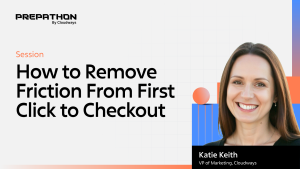
Moeez: Thank you so much Fatih. I think those are wonderful comments. With that note we will conclude the opening keynote. But for everyone watching, please don’t go away because up next we have a session on seamless shopping journeys, how to remove friction from first click to checkout, from Katie Keith. And also I want to remind everyone else to keep on engaging, keep on commenting, asking questions so that you can move up the leaderboard and improve your chances of winning that Amazon gift card by the end of day three. So don’t go anywhere. We will see you again in just a couple of minutes.
Answer a few questions, and we'll present you with a personalized tour of the Cloudways platform based on your answers.