EXPLORE CLOUDWAYS
Experience lightning-fast loading times and seamless platform
View Demo >PRODUCTS
CLOUD PROVIDERS
SUPPORTED APPS
WHO WE SERVE
PARTNERSHIP PROGRAMS
Lifetime deal: 75% OFF
Advanced Support
POWERFUL FEATURES
DISCOVER
WHY CLOUDWAYS
 Read Case Study >
 Jesse Tutt
Founder & CEO

Cloudways rebuilt its hosting stack for speed. In this Cloud Bootcamp 2026 session, the engineer behind the new Lightning Stack explains how it replaces the legacy Apache architecture with a tightly integrated NGINX and PHP-FPM setup, followed by an independent benchmark walkthrough.
🎙️ Speakers
▸ Danish Hameed — Senior Director and Engineer, Cloudways
▸ Jeremiah Broadway — Independent performance influencer
▸ Host: Moeez — Cloudways
✨ Key Takeaways
✦ The legacy Apache stack offered flexibility (.htaccess, deep customization) but stacked many layers, Varnish, Apache, NGINX proxy, PHP, so no amount of tuning could reach the target performance.
✦ The Lightning Stack bakes everything into NGINX and PHP-FPM, eliminating intermediate hops for high concurrency, low latency, and a faster Time to First Byte (better SEO).
✦ Measured gains include up to 58% faster WooCommerce checkouts, 85% higher LearnDash throughput, 33% faster WP-Admin, and 21-27% overall.
✦ The upgrade is free, backward compatible, and one click; just check first for complex .htaccess logic or Apache-specific modules, since only 301/302 redirects are supported.
✦ Both stacks stay available, flexibility on Apache, raw performance on Lightning, so customers choose what fits.
✦ Independent benchmarking found Cloudways premium servers (NVMe, faster CPU) significantly outperform standard servers, with the 2GB 2C premium tier offering the best value for a single WordPress site.
✦ Larger servers make sense mainly for agencies packing many sites, or for heavy WooCommerce and LMS workloads.
Moeez: I think the activity was amazing. I think it was very engaging and a lot of you guys did very well answering those myths and facts. Now we have a session on the new Lightning Stack for Cloudways, and to present that session we have with us, in this session, Danish Hameed, the brains, the minds behind the Lightning Stack, the people who, the team who has worked in the background to make sure that we deliver the Lightning Stack for our customers. He’s a senior director and engineer at Cloudways and I would like to welcome him on stage. Danish, it’s a pleasure having you on stage, and without any further ado, I would just put the spotlight on you. I would ask you to start your presentation because our audience just can’t wait.
Danish Hameed: All right. Awesome. Thanks, Mo. And I hope you guys can all hear me fine. Awesome. All right. So, thank you for an amazing activity, Mo. I’ll jump very quickly onto sharing with our folks what this new Lightning Stack is and what are the breakthrough changes we have made into the legacy Cloudways stack, and introduce the new Lightning Stack for better performance. So I’ll just quickly share my screen. There you go. Just give me one second.
Moeez: Folks, while Danish is sharing his screen I would also encourage everyone to drop your questions in the comment section. If you have anything that you want to ask around the Lightning Stack, around the Cloudways platform, Danish is here to answer your questions by the end of the session.
Danish Hameed: Awesome. So back in mid of 2025 we launched our new stack which is called the Lightning Stack. This is entirely a new. So earlier we used to provide the Apache stack, and as you know that the Apache stack has been there for some time and we have been having a lot of feedback around that stack. While, you know, there are pros and cons with each of these stacks. So we are not, you know, bringing down the existing, you know, Apache stack that a lot of our customers, almost you know 50, 60% of the customers are using now, but it is just to provide the more performant experience to the customers who are looking for better performance getting out of their servers.
So the journey of the Lightning Stack starts from early 2025 when we realize that a lot of customers, especially the e-commerce one and the ones who are running heavy sites on WordPress, are looking for more performance out of their existing servers, and this is where all the idea of coming up with the Lightning Stack started back then. We did a lot of studies onto which stack we should provide and what are the features that are going part and parcel of that stack. So with that research and all of the customer feedback, we came up with the new Nginx stacks which you might have already either experienced or you might have already heard about.
Now, the reason behind that is that a lot of e-commerce websites, a lot of learning management websites, and a lot of community feedbacks were already there for the Nginx stack. A lot of competitions were already leaping towards providing their customers the Nginx stack, and Cloudways couldn’t stay behind in the game. So we realized the need of it, and then we launched a private preview somewhere in the mid of 2025 with a selected group of customers to experience the Lightning Stack. The reason for providing the private preview was to get the customer feedback with the initial launch of the new stack and optimize it further to provide the breakthrough performance experience to the customers when it goes live.
So if you look at, I’ll just quickly go back and share a bit about the legacy Cloudways stack. So earlier I talked about the pros and cons. I’m going to slightly go a little deeper onto what that means. So the Apache stack, as you know, provides a lot of flexibility onto our existing stack. So you can go in and you can play with the .htaccess file. You can, you know, optimize a lot of Apache settings. You can tune a lot of things. You can, you know, have a .htaccess at the directory level. So a lot of customizations are there with the Apache stack, while, you know, the architecture of the Nginx is not that flexible. You don’t have the liberty to make a lot of customization, and you don’t have a liberty to add a lot of configuration into the core Nginx configuration files.
So when we were discussing about whether to either optimize the existing Apache stack or provide a new stack, we realized the fact that no matter how much we would optimize, we wouldn’t really get the kind of performance that we are looking to provide to our customers. So that’s when we realized that, okay, now so we have a challenge where we want our customers to have the flexibility but we also want our customers to have the performance. Now some of the customers prefer flexibility over, you know, the kind of performance Lightning Stack is offering. So they would go for the Apache stack, and while rest of the customers who already think that, you know, they need performance, that they have enough customizations available in the new Lightning Stack, they can go for the Lightning Stack.
So if you look at the high level overview of how the old stack used to work and why we thought that no matter how we optimize it, no matter how we fine-tune it, it’s not going to deliver the performance. You will see that there is a layer of Varnish caching that is there to serve the static or the cache traffic or the page content. And then there is a bunch of, you know, sophisticated components working together to make sure, you know, all of the login users, all of the live checkouts, all of the dynamic content on the page are being, you know, served in a faster way possible with the existing Apache stack. So there are a lot of layers and there are a lot of components with the Apache stack that are in play, and as we know that if we introduce more components, more layers, more complexity, the performance is the first thing that gets compromised. So that’s a little bit of a background on the Apache stack.
A little bit more onto that to give you guys a better visibility. What it means is that whenever a request is made onto the existing Apache stack, you see a bunch of things happening here. You know, either the content is served through the Varnish cache or the content is being served from the Apache web server. So that itself has a little bit of a, you know, a communication hop there, and then where the, you know, images are being served from the Nginx proxy, and then there is an application, PHP application running which is getting interpreted on runtime, and then the application is talking to the database layer. So imagine a request coming in and then going through all of these layers and then eventually you are getting the response on the web browser. It means a lot of, you know, computation and performance bottleneck.
If you look at your right side, there is a Lightning Stack. So in the Lightning Stack your Nginx is bypassing all of these layers because everything is baked into the Nginx and the PHP-FPM and tightly integrated within these two layers. So as soon as your request comes in and lands on the Nginx server, it is directly redirected to the PHP-FPM for processing and sent back to your customer’s browser. So everything in between has been eliminated and been made part and parcel of these two layers.
What that means for our customers, eventually it means high concurrency. It means low latency and Time to First Byte. Now this, some of these things may be, you know, very technical for some of our customers. So what it means is that now you have with the Lightning Stack now you have the ability to serve more users from a single server than you would with the hybrid existing legacy stack. So this means high concurrency. So for example, if on the old stack you were serving thousand customers per second, now with the new stack, you would serve more customers based on how your application is built. So some customers, some applications can serve up to 3,000 customers, 4,000 customers if it’s a very, you know, lean and thin application. But if there’s another application that is more complex in nature and has a lot of logics in place, it may serve a less number of customer, but more than the existing legacy stack.
Low latency means, you know, I’ve mentioned in the previous slide that there are less number of layers through which the request is going and being computed and the response is getting back. So which means that faster load time for your website. Time to First Byte means the first byte that you receive when you make a request to your web page. So this is very important for Google search algorithms or any other search engine algorithms when their crawlers or bots crawl on your site. There is a parameter that checks whether your site Time to First Byte is high or low. So this is a reduced Time to First Byte which means you’ll get better SEO results on the search engines.
And then there is a reduced cache dependency because a lot of content is being served at the Nginx level. Although the cache is there, but there was a very complex mechanism when the pages, in the like in the previous stack, when the pages used to get cached onto the Varnish layer and then, you know, getting eventually served to the customer. So that mechanism has also been overhauled and a new mechanism has been introduced with the new Lightning Stack.
Now so when we did that we said, you know, we can brag about what we have done. We can, you know, really make a noise out there and let people know what amazing performance we have got out of this Lightning Stack. But that wouldn’t be enough. So what we did is that we went to the independent benchmarking company and asked them to benchmark it against the competition and let us know how in actual our customers would experience the performance of this new Lightning Stack. And those benchmarking results proves that the changes and the architecture revision that we have done with this new Lightning Stack is up to the par with the competition, in some cases better than the competition. So you can go onto the Cloudways website and check the benchmark results being published there.
Now what it means, so some of the performance improvements that we have seen. So we have seen up to 58% improved performance on the WooCommerce website checkouts, and we have seen almost 85% throughput improved on the LearnDash courses, you know, LearnDash courses that a lot of customers have been using on Cloudways and have been complaining about performance issues. So imagine an increase of 58% performance and an increase of 85% performance on just these two things. And the reason why we are sharing these two numbers, that for those who use WooCommerce and have experienced the checkout, and those who prepare LearnDash courses and have seen how much complex the logics are behind and how much time it takes onto the regular Apache stack or any other stack to process this complex logic is insane, and having 85%, 58% performance improvement there is a huge accomplishment.
Now overall if you see, we support thousand plus concurrent users without Varnish. So what it means, that every request that you get onto your website is being served from the Nginx stack without any caching. So imagine if you add cache on this, a layer where all of the static content is being stored and served directly from there. For example, whether it’s Cloudflare, whether it’s internal baked cache of the Cloudways web stack, you’ll get two or three or 4x better performance out of that based on how your application is being developed.
33% faster load time on WordPress admin. So, this is another important thing. A lot of our customers, especially the agency customers, they used to make a lot of activity on WordPress admin, and for that sometimes the WordPress admin used to perform slow. With this new stack the WordPress admin is consistently performing above 33%. And an overall gain of performance, you know, with simple sides and ranging from the most complex sides, is between 21 to 27% and more depending on how your website is being developed.
Now you may have a question, and I’ll try to be mindful of the time as well. You may have a question that, you know, what about the flexibility? We used to have a lot of flexibility on the Apache stack to write some of the rules, for example the rewrite rules or redirect rules, since this is not natively supported by Nginx. What we have done is that we have added another option into the Cloudways platform where you can go in and set the redirect rules, 302, for your website redirects. So instead of going in and writing the .htaccess, you can go into the Cloudways platform and write these redirect rules there, and you’ll get the same or better performance as you would get on the legacy Apache stack.
Now, so upgrade is free. You can go, for example, if you have a website right now running on the legacy stack, you can just go in and upgrade it to work on the new Nginx stack without any technical complexity or without having to have any technical understanding. You will just click a button and your existing website running on the legacy Apache stack will be then automatically migrated to the new Nginx stack. The stack is backward compatible also. So for example, you know, if you have old versions of WordPress, Magento, Laravel running, don’t worry about that. The stack is compatible with them as well, and you will get the seamless migration from the old stack to the new stack.
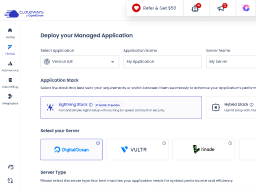
The infrastructure is transparent, just said, you can either use DigitalOcean, multiple, you know, different types of instances worldly node. So there is no compromise made over there that, you know, this new stack is only available on specific types of machines. So you can just, just like you use the previous stack with any of the standard configuration or options you would choose at the time of launching the server, you can still do it with the new stack as well. So here again you can either migrate single side. If you have multiple sides you want to migrate them all together, you can go and use the bulk migration for that. All you’ll have to do is to navigate to the application setting. Inside the application setting you’ll see a stack setting section, go there and select the Lightning Stack and click Update Now, and that’s it. Everything will be done instantly and seamlessly.
Now before you switch, make sure that your application doesn’t have any complex .htaccess logic that is not supported by the new stack. So right now the new stack supports 301 and 302 redirects. It does not support any other complex .htaccess logic. So make sure your application doesn’t have that. If your application is using any Apache specific module, those modules are not out of the box supported in the new stack, because obviously those modules belong to Apache and they’ll work on Apache only. So if you want to move your application from Apache to Nginx and there are modules that are specific to Apache, you would either need to change something in your application to make sure you’re using Nginx compatible modules. It will work with Nginx then, otherwise your application may have issues running onto the new stack. So these are the two things that you’ll have to make sure before migrating your application to the new stack.
All right, so I think I’m almost there. I would encourage everyone to go and test your website onto the new stack. You don’t necessarily have to move your existing workload onto the new stack. You can just spin up a new application on the old stack, benchmark it, and move that same application to the new stack and benchmark it, and you see a significant difference between these two. So just to call out separately, new stack is there. It’s not going away. It’s going to stay there because bulk of Cloudways users love that stack because of flexibility and customization options available there. But, you know, as we know there is a huge demand for the performance, and this new stack is there to cater that. Thank you very much.
Moeez: Thank you Danish. This was fantastic. We have a few questions in the comment section around Lightning Stack. So if you can take them one by one. So Stephen asks that, will Lightning Stack improve my WordPress speed if I have a lot of plugins.
Danish Hameed: Absolutely. Absolutely. So the new Lightning Stack doesn’t have any specific criteria whether the plugins are there on the website and only then it’s going to perform well, or without plugin. Anything that is running on the existing stack is going to seamlessly work on the new stack whether the plugins are there or not. You’ll significantly see a major difference in the performance. So there is no like there is no differentiation of whether plugin is going to have any issues or not. It’s just there, supported out of the box.
Moeez: Perfect. We have another question from Shelly. She asks that, do we have to do anything in our accounts to take advantage of this new setup? Like does it cost extra? She’s asking how can she enable that on our servers.
Danish Hameed: So it’s by default enabled for everyone. It’s free. It doesn’t cost anything extra. All you’ll have to do, just like I’ve said, all you have to do is to go inside the application settings and then, so when you log into Cloudways you see the application settings section. Go in there, select your application. Inside that application, you’ll see stack settings. Go there and change the stack to either legacy or the new stack, Lightning Stack. And it’s completely free of charge. You don’t have to do anything extra.
Moeez: Awesome. That was amazing. Danish, thank you so much for this presentation. The next part of the session is from Jeremiah Broadway. I would like to call him on stage now. He is an independent performance influencer. He benchmarks different hosting provider and he recently benchmark our Lightning Stack, and he has some findings to present to this audience and some questions that I would like to ask him. So Jeremiah, the floor is yours. You can show us what you have.
Jeremiah Broadway: Hey guys, thanks for watching and tuning in. Yeah, so I do a lot of web hosting content and I’ve been testing out a lot of Cloudways infrastructure. I mean I’ve used Cloudways for a long time independently just because I really like the tech stack that they have, and the developer tools that they have available is like super nice. So this year I decided to just benchmark a bunch of their infrastructure just to see how the standard servers compared to the premium servers, and I was able to make some pretty decent insights. I’m just going to share my screen here. Let’s do this and we’ll do screen one. Share.
All right. So, I have a few photos here. Basically, the way that I benchmark Cloudways is I just did a bunch of backend tests. I did do some front-end tests, but I found that the backend tests were more conclusive and more interesting. So, that’s what I’ll be sharing with you guys here today. So the backend test, basically I tested the database read and write speeds to the MySQL database. I also did an admin experience test where I was simulating basically a bunch of WordPress, what would you say, WordPress just simulated tests. So like adding posts, you know, adding taxonomy like categories, and then just determining how long that takes.
And then I was also, yeah. So anyways, I’ll just get to the graphs here. So for the database read and writes here, you can see that inside the orange you have the standard servers and in the blue you have the premium servers. And what I found is that the premium servers definitely, they like significantly outperform the standard servers. So, and the database reads here obviously you have lower is better, and the premium servers on the x-axis here you have the server size. So, from one gigabyte to two gigabytes here, if I zoom in a little bit, maybe you can see a bit better. So I tested the database writes and then the reads. And then I also tested the SSD, the solid state drive, for the write speeds and the read speeds. And yeah, like the premium servers, they did significantly better.
And here was the admin experience tests where I did, so basically I was doing like post saves, taxonomy, which is like how many, like if you’re adding a category and removing it, like messing around with the options. So it basically simulates what you’re doing in the WordPress back end. And the premium servers just like absolutely demolish the standard servers, which was really surprising to me because for me, like I’m making pretty small sites, so I’m usually just doing the one gigabyte standard server, but after like doing these test results, it made me reconsider just like, okay, I think I’m going to bump up to the premium servers just because of like how much better it’s looking.
So if we take those two tests and then we aggregate it into a performance score, and the way that I do this is I basically weigh each metric and then normalize it, without getting into like the super technical details, this kind of gives me like an overall score to like benchmark how the servers do. And, just once again, like the premium servers just completely like outdid the standard servers. But then another interesting thing is like, okay, if you’re looking at just the performance itself, you want to know how much that performance is actually, you want to know how much that performance is worth relative to the amount of money that you’re spending, you know, because if you have to spend like a ton of money on a super expensive server then it’s like not really worth it, right? Like obviously you want to get the most efficient server for the least amount of price possible. So I ended up weighing the performance score by value, and this is where this metric or this chart comes in from.
So you can see from the premium servers, like at the 1 GB tier, like the premium server is like an absolute steal over the 1 GB server. So this was like one of the reasons why I was like, okay, I’m just not going to use the 1 GB standard server because the premium, just in terms of the raw value, is like beating the standard server, right? And then interesting here, once you get to after about 2 GB 2C, it starts plateau, it plateaus off and it kind of diminishes down, which on the surface it might seem like, okay, does this mean that the higher gigabyte servers are just like not worth it? And the answer is like it’s a bit more nuanced than that. Like if you’re running a single WordPress site, basically the conclusion I came to is like the 2 GB 2C is basically like the maximum capacity for a single WordPress site. Like if you pay for a larger server, you’re not really going to get much more of a performance increase unless you’re running like a super large like WooCommerce site or if you’re running like a large LMS system.
So if you’re running a single site, to me it looks like the 2 gigabyte 2C premium server is like the best. And then where it makes more sense to do like the higher tier servers is if you’re an agency and you’re trying to cram a bunch of sites on a single server. Then that’s when like the 4 GB, 8 GB, 16 GB, you know, and all the way up make a lot more sense. But consistently like throughout like all my tests, the premium servers like beat the standard servers.
I also tested degradation. So basically just like, which was, I kind of got volatile results with this, which is basically I wanted to test like if you’re sending a bunch of requests to the server, like how well does the server do under sustained load, and that’s kind of what this degradation test tested out. And as you can see it’s kind of volatile, like there wasn’t really anything consistent with this test. Like some servers did really well, other servers didn’t do very well, and I don’t know, like to me this test is kind of just like, it just seemed like a little bit of noise to me because, depending on like, I don’t know, I don’t know if there’s much signal to extract out of this. I’ll just leave it like that because like sometimes servers did really well, other times they didn’t do really well. So I think there’s like some sort of noise that’s unaccounted for, at least with a cloud infrastructure that I’m not really understanding, but at least like that’s the results there.
So like price versus features. So this is basically just, this isn’t related to the benchmarks necessarily. This is more so related towards the amount of like feature set that Cloudways offers versus like the price that you’re paying for. And one of the things that I really like about Cloudways is they pretty much give you like a full developer suite even at the lowest plan possible. So that to me, like Cloudways is like hands down the best value. Because, you know, Cloudways offers a bunch of stuff that other premium hosts like WP Engine, Pressable, Kinsta, they offer these features but they keep it behind like a paywall. So you got to pay more for those features.
But so anyways, just another graph, like value index comparison. So this is basically looking at the price versus performance for front end versus backend. So you can see like the best value, Cloudways optimized here, Hostinger, DreamHost, GreenGeeks, backend performance, and then best overall value I found is like with Cloudways, with like optimized performance, is like, does really good. But this graph is more so towards 1 gigabyte standard server with optimizations made in the back end. But yeah, so that’s pretty much what I have for you guys. I’m going to switch back over to the, to stop sharing my screen.
Moeez: But, yeah, thank you Jeremiah. This was really useful. One thing that people have pointed out in the comment section is that they would want you to share either your slides or the images that you shared over here so that people can at least see them.
Jeremiah Broadway: Yeah, I can, I just drag them into the chat. Will that work?
Moeez: Yeah, you probably will have to like put them on a slideshow and then share it with the team or with the people on the chat here.
Jeremiah Broadway: Okay. Yeah. Yeah, I can do that. I’m seeing if I can just drag like stuff into the chat. It doesn’t look like, oh, wait. Let me see. Oh, no. Yeah, it just puts the URLs.
Moeez: Yeah. So Jeremiah, I do have a few questions for you regarding your benchmark and what you sort of used to benchmark the Lightning Stack. Can you walk us through the approach that you used to benchmark your Lightning Stack? How did you ensure the tests reflected real world WordPress use cases, especially sites with dynamic content and complex redirects?
Jeremiah Broadway: So for me, I basically just went through the Cloudways onboarding process. I didn’t want to tweak anything with at least my Cloudways benchmarks that I did. So, by default, the Lightning Stack comes default when you have a server. So, I just, that’s what I ended up benchmarking. And I tested primarily just raw server speeds. So, if, so I didn’t like, I’m not in a position to just like spin up like a full-fledged WooCommerce or LMS site. So I just literally tested the raw benchmark or raw performance for each site, and then from that that gives you a good foundation I think to extrapolate upon, you know, what else the server is going to be able to run, because I mean if your base server is not benchmarking well then it’s like how is it going to be able to support stuff with dynamic content and a bunch of other stuff.
Moeez: Awesome. And a follow-up question on that, did you specifically test scenarios like dynamic content, complex plugins, or redirects that many WordPress sites rely on?
Jeremiah Broadway: Yeah. So for that, I did front-end tests because I feel like that is more, a lot of that is more front-end based. Like for example, I had a test where I installed Elementor on the sites because Elementor is one of the largest themes in WordPress. And then I created a page that had like all the bunch of like every single widget from the essentials plan. And then I timed out like how to, I timed loading it with like a stopwatch. And like in that test, again I found that the premium Cloudways servers were running a lot faster than the standard servers. So, and then I also did like Google PageSpeed Insights on the theme too. And I found that like with Cloudways, the server size didn’t really make a difference on the Google PageSpeed Insights. It was pretty consistent regardless on if you were on standard or premium. So, so does that answer your question?
Moeez: Yeah. Yeah, definitely. I want to ask a few more questions because we do have a few more minutes before we end this session. What were the most significant performance improvements the Lightning Stack achieved compared to the previous hybrid stack? Now this is a comparison between the new stack and then the previous stack of course. Were there any surprising findings particularly for uncached or high traffic purpose sites?
Jeremiah Broadway: So I didn’t test the old stack. Like all the tests I did was just purely on the Lightning Stack because that’s what’s installed default with Cloudways. So the difference I did find though was the difference between the premium servers and the standard servers. Like in the past I was just basically building all my sites with the standard servers because it’s like that’s the cheapest. And you know most people, they just want like a good server for the cheapest price possible. But like after running these benchmarks, just seeing how much better the premium servers did because of the NVMe storage and the faster CPU, that like convinced me like, okay, like I kind of don’t want to use the standard servers. I just kind of want to use the premium servers. So that’s the main comparison that I tested.
Moeez: All right. My last question for you, Jeremiah, is based on your benchmarking results, what advice would you give to users with large or complex WordPress sites to get the best performance from Cloudways?
Jeremiah Broadway: So it depends. It really depends on the context and what you’re trying to do with WordPress. Like if you’re hosting a single site and you’re not doing WooCommerce, like the 2 gigabyte 2C premium server is like, that’s in my test, that’s like the maximum server that is best for a single site, because if you try to upgrade to a 4, 8, or 16 gigabyte server, it’s like you’re not going to be able to, there’s too many bottlenecks within WordPress to actually utilize that server size because WordPress doesn’t scale linearly. So if you’re hosting just like a single site, like 2 GB 2C server, that’s a really good server. Now, if you’re doing WooCommerce or if you’re doing like a learning management system, that’s when having the larger server size could be beneficial. But at the end of the day, it’s like, I would say if you’re a small business owner, like yeah, 2 GB 2C server is going to be good. If you’re doing WooCommerce, you need more RAM, then you can explore those larger server sizes, you know, and I guess don’t be afraid to like benchmark and test too, because you really don’t know what the difference is unless you actually do a benchmark and you run a test.
Moeez: Awesome. Thank you so much Jeremiah. This is it from this session, folks. I want to thank Jeremiah and Danish for popping up here and telling us all about the new Lightning Stack. So thank you Jeremiah and thank you Danish for doing that. As for you folks, we have one last session remaining for day one of the performance boot camp, and this is a big one, right? So we saved probably the biggest session for the last, page builders. How to keep feature-rich WordPress sites under two seconds. So I’m sure a lot of you use page builders, a lot of you use forms as well, and they both have some sort of an impact on website performance, and I would like you all to stay back and watch the last session of the day because the guests are none other than people from Elementor and people from Gravity Forms. So two mega mega WordPress tools, and people from those tools will be coming up on stage and telling us all about how we can keep WordPress sites under two seconds if you have page builders and forms on them. So don’t go anywhere.
Answer a few questions, and we'll present you with a personalized tour of the Cloudways platform based on your answers.