EXPLORE CLOUDWAYS
Experience lightning-fast loading times and seamless platform
View Demo >PRODUCTS
CLOUD PROVIDERS
SUPPORTED APPS
WHO WE SERVE
PARTNERSHIP PROGRAMS
Lifetime deal: 75% OFF
Advanced Support
POWERFUL FEATURES
DISCOVER
WHY CLOUDWAYS
 Read Case Study >
 Jesse Tutt
Founder & CEO

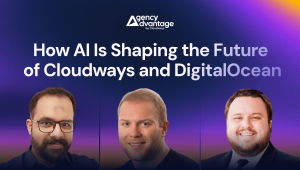
Leaders from DigitalOcean and Cloudways show how AI is being built into infrastructure and hosting, from GPU access and serverless AI models to an AI assistant that monitors servers, finds the root cause of issues, and recommends fixes, capped by a longtime customer’s real-world take.
🎙️ Speakers
▸ Matthew Makai — VP of Developer Relations, DigitalOcean
▸ Ali Ahmed Khan — Director of Product Management, Cloudways
▸ Blake Whittle — Owner, ClikIT (Cloudways customer)
✨ Key Takeaways
✦ DigitalOcean’s mission is to simplify the cloud so developers can focus on building for their customers.
✦ Its AI stack runs from bare-metal and GPU Droplets up to Kubernetes, a GenAI platform, and serverless AI models you call with an API.
✦ Developers today use these for text summarization, data analysis on huge unstructured datasets, code generation, and customer-facing agents.
✦ Cloudways Copilot is an AI assistant (in public preview) that monitors servers, diagnoses the root cause of issues, and recommends fixes.
✦ Coming soon: one-click fixes, coverage for more server and application errors (like 403/503), bulk task commands, and AI-powered pre-production testing.
✦ The goal is for Cloudways to become the world’s first “agentic” hosting platform.
✦ Blake Whittle’s agency (10 servers, 200 apps, developer team) cut issue resolution from an hour to about 10 minutes with Copilot.
Host: And we are back to continue with day two of Agency Advantage. Give it up for Karl and Robert for an amazing session, I think that was very insightful and informative. I’m here to take you forward for day two, and with me today I have Matthew Makai from DigitalOcean. He is VP of Developer Relations, and he is going to be taking us through DigitalOcean’s vision and how it’s being reshaped through artificial intelligence. So Matthew, thank you so much for being here, I appreciate your presence, and the floor is yours. You can share your screen and start your presentation.
Matthew Makai: Sounds great. Hey folks, my name is Matt Makai. I have the privilege of serving as the VP of Developer Relations at DigitalOcean. I’m going to share just a few slides that’ll walk us through the AI vision with DigitalOcean.
This is going to be essentially vision plus, I always like to have the practical side of things, so a big piece of this is not just hype around AI, it’s really what are developers doing today and then what are we enabling with use cases as DigitalOcean continues to build. Just to start with the mission, and this is true from the founding of DigitalOcean and it has so much impact on Cloudways as well, which is simplifying the cloud, and now AI, so that builders, software developers, can spend their time building software that is best for their customers and idealistically changes the world. Really, just think about it as getting out of the way and making it possible to best serve your customers.
So why DigitalOcean? Our approach here is to be simple and scalable and, in general, approachable as a brand. And that’s what you’ll see from the customers that are built on DigitalOcean. This has historically been true since we were founded in 2012. I actually was a customer long before I joined DigitalOcean, and these quotes really resonated with me as to why I had been a customer for so long.
So let’s talk about what DigitalOcean is doing as far as artificial intelligence. We really started out with GPUs and bare metal. What that means is you can just get access to GPUs, and it gives you the most control over, typically you’re going to be running large language models or AI models on the GPUs, so there’s a tremendous amount of compute required. This is kind of how companies have done things before there were abstraction layers on top of AI, you’d have to go get the GPUs, configure clusters. Ideally you’re not buying all the GPUs, but instead you can lease them, you can get them from companies like DigitalOcean. That was the first step to making AI easier, you can just get access to this hardware. So think about the bare metal GPUs as that base step. If you want the most control over your AI models and the way that you’re running infrastructure, this is often how many companies will go. But there’s so much more that can be built on top of that, and that’s really where DigitalOcean has gone.
The first step on top of it was GPU Droplets. DigitalOcean has been known for a long time for CPU Droplets, the idea is you have a virtual private server with an abstraction on top of it, you get a tremendous amount of bandwidth and storage and the CPUs with it. Just like we’ve been doing with CPUs for over a decade, we’re doing with GPUs now, the abstraction layer on top of the GPUs in the form of GPU Droplets, being able to access these things on demand, all sorts of different types of GPUs, both from Nvidia and AMD hardware. So that’s your first level of infrastructure that we already provide and have been providing for several years now.
So if you look at the bottom layer here, if you want the most control over running your AI models, and you have the most skills deployed in managing infrastructure, you’re probably going to be running bare metal or GPU Droplets. One thing about GPU Droplets is that a big abstraction layer on top is you can just do one-click deploy. You want to deploy that text-to-speech model or the speech-to-text model or a large language model, you can just do that with one-click deploy on GPU Droplets. But we know that for many companies this is just not a viable model. You’re not going to go hire an entire team of developers to write software just on top of the bare metal instances of GPUs. What you really want is to say, I’ve already got some infrastructure, I want to use that with some AI applications.
So that’s where there’s a couple of other areas of the stack. We’re building abstraction layers on top of the bare metal hardware and the GPU hardware. So there’s DOKS, DigitalOcean’s Kubernetes service. You can use Kubernetes with the GPUs. You might have your existing hardware, you want to deploy that with LLMs or other AI models, and you can do that very easily by connecting your existing infrastructure, your more traditional software running on Kubernetes so that it’s resilient and scalable, and you want to connect that with GPUs, we make that very easy. And then on top of that is our GenAI platform, where you can easily build with large language models and you essentially just run these large language models on your own instances. There’s also access to, let’s say you want to do an API call, I’m a software developer, I want to just call these large language models and pay for the tokens that go in and out of these models, you can certainly do that as well.
On top of that, what we’re increasingly seeing is agentic use cases, the software around all the things that are being built with large language models. Think about this as where you are in your own business journey with AI, we can provide it at different layers of the stack. If you’re just starting now, there’s a lot more software available for you to work with on the top layer. It’s not like five years ago where you have to go buy or lease GPUs in a data center and write all the custom software on top of that, that’s just not really how you have to get started today. So we provide at that top layer serverless inference. What this means is you can just run AI models, and we essentially are already running them, you just call them with an API, and we have tools for building and running agents on top of DigitalOcean.
Here’s a little bit about what developers are building. We have serverless inferencing, which is these AI models. There’s a ton that developers are doing today, this is not something in the far future: text summarization, classification, a lot of data analysis around semi-structured or unstructured data. I personally have a side project where I have a hundred thousand blog posts from a bunch of different companies, and I do all sorts of data analysis on those blog posts with large language models. I ask them what phrases are trending over time, what topics are popping with developers. You can ask hundreds of thousands of questions of large unstructured data sources in ways that you never could before the advent of really cheap and available large language models. You can also do all sorts of searching, sentiment analysis, those sorts of things, and certainly code generation is a big one. A lot of times you’re using things like Claude Code, Google had their Gemini CLI that was released today, there’s so much happening in being able to write code with large language models, especially if you’re an experienced software developer.
And likewise on the right side here is the agent development, which is a higher level of abstraction, the idea here is you can build these agents that will handle your internal use cases, internal knowledge management, or assistants that will be able to answer a lot of questions for your customers with very low effort or no effort, no human in the loop. These are the types of use cases that people tried to build chatbots for 10, 15 years ago that just didn’t work, because there was no large language model foundation to answer ad hoc questions or understand what a customer is asking and be able to get them the right answer out the other side. So that’s a lot of the use cases we’re already seeing, and if you’re not building these things already, don’t feel like you’re too far behind, so much of this has really rapidly evolved over six to 12 months. But there are a lot of these applications already deployed at scale at many companies, and it will just become more and more prevalent over time because there’s so much value in the things being built here. Look for the higher abstraction layers, whether you’re building directly with DigitalOcean or you’re working with Cloudways, to build your AI use cases. One thing I’ll plug is you can access all this on DigitalOcean today, everything I talked about, you can get access to it today. So with that, I will turn it over and talk about Cloudways in view of AI.
Host: Thank you, Matthew, I think that was very insightful. So folks, if you have any questions for Matthew, please drop them in the chat, and Matthew will be here with us for the remainder of the session to answer those questions for you. Up next, now that we’ve learned what DigitalOcean is doing with regards to AI, we cannot forget what Cloudways itself is doing when it comes to AI. So for that, today I have with me Ali Ahmed Khan from Cloudways, who is the Director of Product Management. Ali, thank you so much for being here. People are waiting to know what Cloudways is doing when it comes to AI, what is Copilot, and how it is helping businesses around the world. So Ali, the floor is yours.
Ali Ahmed Khan: Thank you, Moeez, and hi everyone. Glad to have this opportunity to talk to you guys over here about Cloudways Copilot. I’ll quickly share my screen to walk you guys through some slides that I’ve prepared for this session.
So some of you may be aware that Cloudways Copilot is a new AI assistant, or you can say SRE assistant for now, that we have recently introduced into the Cloudways platform. It’s currently in public preview, and what it does basically is it proactively monitors, diagnoses, and helps you resolve server-level issues at the moment. Now, I’m saying server-level issues, this might seem limiting, but in the upcoming slides I’ll talk about what’s coming soon, and there’s a lot of exciting stuff that we’re working on that I want to share with you guys.
So you might think, okay, Cloudways Copilot, an AI system, what is the benefit that it delivers to me as a customer? Today, when for example one of your servers goes down, you go in and try to identify the root cause of the problem, in order to come up with the steps that you want to take yourself, or through your team members, or through our support team. Now this entire process is quite laborious and takes a lot of time. So what Cloudways Copilot is doing today for you is to eliminate all this wastage of time, and it quickly surfaces an insight which tells you the root cause behind the problem, why your server went down, and it also tells you the recommended steps that you can take on your own to resolve the issue.
Whenever any of your servers go down for any of these four reasons, web stack issues, host issues, disk inode issues, or your disk space is full, these four issues are the current coverage of Copilot, and we are increasing it with time. Whenever any of these issues happen on your servers, Cloudways Copilot will kick in, it will go onto the server level, troubleshoot the issue, identify the root cause, and come up with the insight. Now let’s quickly look at it inside the platform as well. I just wanted to quickly show you guys what it looks like. So I’ll switch my screen over to the Cloudways platform.
So this is the dashboard or homepage of the Cloudways platform, and you guys can see here the first fold is dedicated to Cloudways Copilot, and it clearly tells you the types of disk issues. Normally this count is too high, normally you won’t have these many issues, but since this is a test account and we are testing it very rigorously, that’s why the count is too high. It shows you the type of issues that you have across the fleet of your servers. And let me quickly go in and show you one insight as an example. You access the insights by clicking this button. Let me filter disk usage. So this tells me that on this server there’s a disk space alert, probably because of which my server is down. And when I click into it, it basically tells me the investigation summary where it has very clearly identified the root cause behind the reason. It tells me that there’s a massive log file, and the reason behind the log file being so big is some sort of conflict with this theme. And it also tells me the remediation steps that I can take on my own to resolve the issue. So it tells me, okay, address WordPress debugging and clear the log file, fix the theme code errors, it even tells me the line number where I need to go and focus, and it also tells me to address Redis configuration issues. So this is what it looks like today, and you guys can have access to this on our platform as well just by reaching out to one of our team members. Now I’ll move back to the presentation.
Host: While Ali is sharing his screen, I just want to mention that you can see the form in the chat. We have pasted a form in the chat where you can drop your details so that we can get in touch with you if you’re interested in Copilot or the agency partnership program. Ali, you’re on.
Ali Ahmed Khan: Thank you, Mo. So let’s quickly talk about what’s coming soon in Copilot. The first thing I want to talk about is something that I personally believe will bring massive value to our customers, and it’s the fix capability. So you saw the insight, the example that I showed you, it was telling you to take some actions. Now, even after having that insight as a customer, you either would have to perform those actions on your own to resolve the issue, or get in touch with our support team and they will perform those actions on your behalf. Now with the fix capability, under that insight there’ll be a call to action where you will just have to click that button and Cloudways Copilot will resolve the issue for you within a minute or a couple of minutes. This is going to be massive, because it eliminates all the friction points and all the time that you invest today from the detection of an issue to resolution of an issue, and Cloudways Copilot will take all that burden off your shoulders. In the slides you can see some examples like resolving disk issues, fixing broken layers in the web stack, deleting log files, resolving plugin and theme conflicts. The timeline for this release is in the next two to three weeks we’ll be releasing this in public preview.
The next thing I want to talk about is, I told you currently Copilot works around four different types of server-level issues. What we are now doing is increasing the server-level issue coverage by including more issue types like backup issues and MySQL issues. But more importantly, we are also working to bring the application-level issues into the coverage. By application-level issues I mean, for example, if your website has a 403 error or 503 error or any other error on your website, Cloudways Copilot will be able to generate a similar insight for your application-level issues and will also offer you the fix button, using which you can resolve the issue in just a couple of minutes. So we are working on a few use cases that we want to cover, and the timeline for this increase in coverage, both server-level and application-level, is by end of Q4 2025.
The next thing is automated task management. Today a lot of our customers have to do a lot of laborious tasks on the platform. For example, if you want to purge cache for multiple applications at once, or enable an add-on on multiple applications, or take backups for your applications or servers in a specific region or for a specific client, you have to go to each server’s screen to perform that action one by one. With this capability you will just command the Copilot and it will do that action for you in bulk. So an example would be, “Hey Copilot, please purge cache for all my applications which are in XYZ region or which belong to XYZ client,” and Cloudways Copilot, based on the go-ahead that you give it, will just go and do that action for you. This is going to take a lot of time off your shoulders again, and our agencies will be able to focus on the core thing, which is the growth of their businesses. The timeline for this one is by end of 2025.
The last one is a big one, AI-powered website testing. I personally believe this is a big pain point for a lot of customers, not only Cloudways customers but across the hosting industry. The idea here is, imagine you are pushing some sort of change to your production website. Currently you have to do the testing through your team members or on your own. Now Cloudways Copilot with this capability will ensure that whatever change you are pushing to production does not break anything on production. For example, you have an e-commerce store and you’re making some sort of change to the production environment, Cloudways Copilot will assess the change that you are pushing and it will tell you beforehand that this change is going to cause this conflict, do you want me to resolve this for you before you push the change to production, and then the Copilot will resolve the issue for you. So the timeline for AI-powered testing is it will be available in early access in early 2026. And this is not where it will stop, we have a very aggressive road map, and this is just a bit of it for Cloudways Copilot that we are working on. I’m really hopeful that we are working towards a near future where Cloudways is basically the world’s first agentic hosting platform. That’s all from my side, thank you guys.
Host: Thank you so much, Ali, that was great. So anyone in the chat who wants to ask any questions for Ali, I can see a few questions regarding Copilot, so you can hop in the chat and Ali will answer those. If anyone is interested in Copilot and the agency partnership program, all they have to do is fill out the form that is pinned in the chat, and our team will try to get in touch with you as soon as possible. Now this is my favorite part. Now that we know what Cloudways is doing with regards to AI, and what DigitalOcean is doing, we have a customer with us today who has been using Copilot for his agency for quite a few months, and his name is Blake Whittle. I would like to call him up on stage and ask him a few questions around how Copilot has been working for him. So Blake, thank you so much for being here. If you can take us through how Copilot has helped you elevate your business processes, and your general feedback about the feature.
Blake Whittle: Yeah, thanks so much for having me. It’s been great within our agency. We manage about 10 servers and about 200 applications, and all of the team members that I have on my agency are developers. They’re not necessarily DevOps people, they’re not necessarily server people, and so that’s why we went with Cloudways in the first place. But there was still that occasional problem that popped up every now and then that we would have to really spend some time looking into, seeing why the MySQL went down and what application is causing that. With Copilot that’s really eliminated that for us. So if a server crashes, it’s typically because an application, meaning a WordPress website, has gone rogue essentially, some URL has gotten stuck or something. And so now we log into Cloudways, we see there at the first fold the web stack issue, we click into it, it tells us what specific application caused that problem, and it tells us what steps we can take, if we need to run some CLI commands it tells us the exact values that we need to run and what the problem is. So that’s really cut down our investigation time and our resolution time. It used to take us an hour, now it probably takes us 10 minutes tops to get our web stack back up and our server back up.
Host: Awesome. So it saves you time and money, and it’s making your processes even better. Any suggestions you would want to give to fellow agency owners here in the chat on how they should adapt AI, and whether they should be looking for products like Copilot to make their workflows even smarter?
Blake Whittle: I think AI is the future, and I was super happy to see Cloudways come out with Copilot. When ChatGPT and all the AI first came out, I was kind of wondering how web hosts would implement this and make our lives as agency owners and web builders better. And we have some hosts out there that made their own web AI builder and whatnot, and Cloudways has done Copilot. It’s really been a game changer for us for making our lives easier, saving us time, efficiency, and all that equals into money. So props to Cloudways for making my life better as an agency owner. And that’s why I’ve been a proud customer since 2016.
Host: That’s super awesome to hear, Blake. Feedback like that from customers like you who have been using us and our features for so long. I want to thank you for your time and your efforts, and for being here for our event and making it even more insightful for the rest of the attendees. So thank you so much, Blake. This is it for this session. Next up we have “The End of Traditional Outsourcing” from Tom Wardman. We will take a short break and then we will be back with the next session.
Answer a few questions, and we'll present you with a personalized tour of the Cloudways platform based on your answers.